

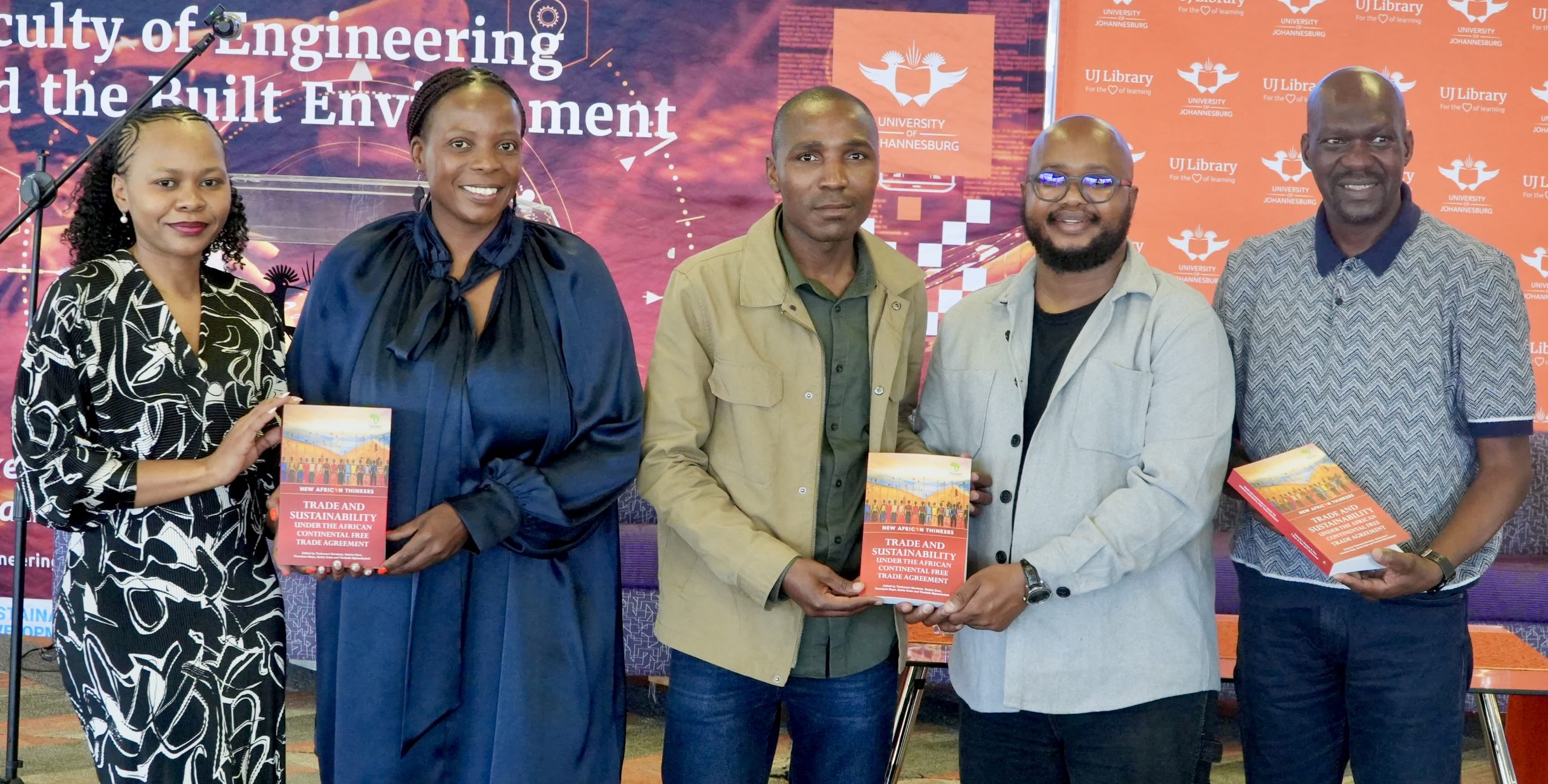
On 09 July 2026, the University of Johannesburg’s Faculty of Engineering and the Built Environment, in partnership with the Human Sciences Research Council (HSRC) Press, launched the book New African Thinkers: Trade and Sustainability Under the African Continental Free Trade Agreement. The hybrid launch was held at the University of Johannesburg (UJ) Auckland Park Campus, Gauteng, South Africa. Attendees were from various countries, including South Africa, Zimbabwe, Uganda, Malawi, India, and Finland.
The book, edited by Professor Thokozani Simelane (HSRC), Dr Nosisa Zaca (HSRC), Dr Thembani Moyo (UJ), Dr Buhle Dube (UJ), and Professor Thulisile Mphambukeli (UJ), comprises a collection of diverse perspectives on the African Continental Free Trade Area (AfCFTA), exploring the trade, agriculture, energy, and sustainability nexus. The lead authors of the chapters in this book are emerging African scholars (i.e., new African thinkers) who critically examined the transformative potential of the AfCFTA. The authors offered rigorous analysis and actionable blueprints for policy reform, technological innovation, and structural change that point towards the African continent’s future.
Professor Simelane welcomed attendees to the book launch and described the publication as a reflection of the intellectual contributions of young African scholars. He briefly highlighted that the book originated from the Africa Young Graduate Scholars Conference, the flagship capacity-building programme organized annually by the HSRC, which was established to provide emerging African researchers with a platform to present their research, receive peer review, and publish their work.
In his keynote address, Professor Siphamandla Zondi (UJ) highlighted that the launched book should serve as a strategic resource for advancing discussions on sustainable trade and development under the AfCFTA. He noted that the book’s research provides a foundation for addressing critical issues, including industrialization, climate change, food security, the just energy transition, digital trade, and inclusive development, while informing policies and practical actions towards Agenda 2063. Professor Zondi emphasized that the research should move beyond academic inquiry to identify opportunities and solutions, foster partnerships and dialogue, and support the implementation of the AfCFTA in ways that respond to the needs and aspirations of the African people.
The panel discussion was moderated by Dr Rodney Managa (Council for Scientific and Industrial Research) and featured book contributors Mr Bonginkosi Ngwenya (South Africa), Ms Lusungu Molefi (Malawi), and Mr Edmore Chijoko (Zimbabwe). During the discussion, Mr Ngwenya presented on the inclusion of differently-abled citizens in elections as a means of enhancing sustainable development, using the Democratic Republic of the Congo as a case study. Mr Chijoko discussed the importance of building resilient peace for the successful implementation of the AfCFTA, while Ms Molefi reflected on South Africa’s just energy transition from coal to the hydrogen economy within the context of the AfCFTA.