


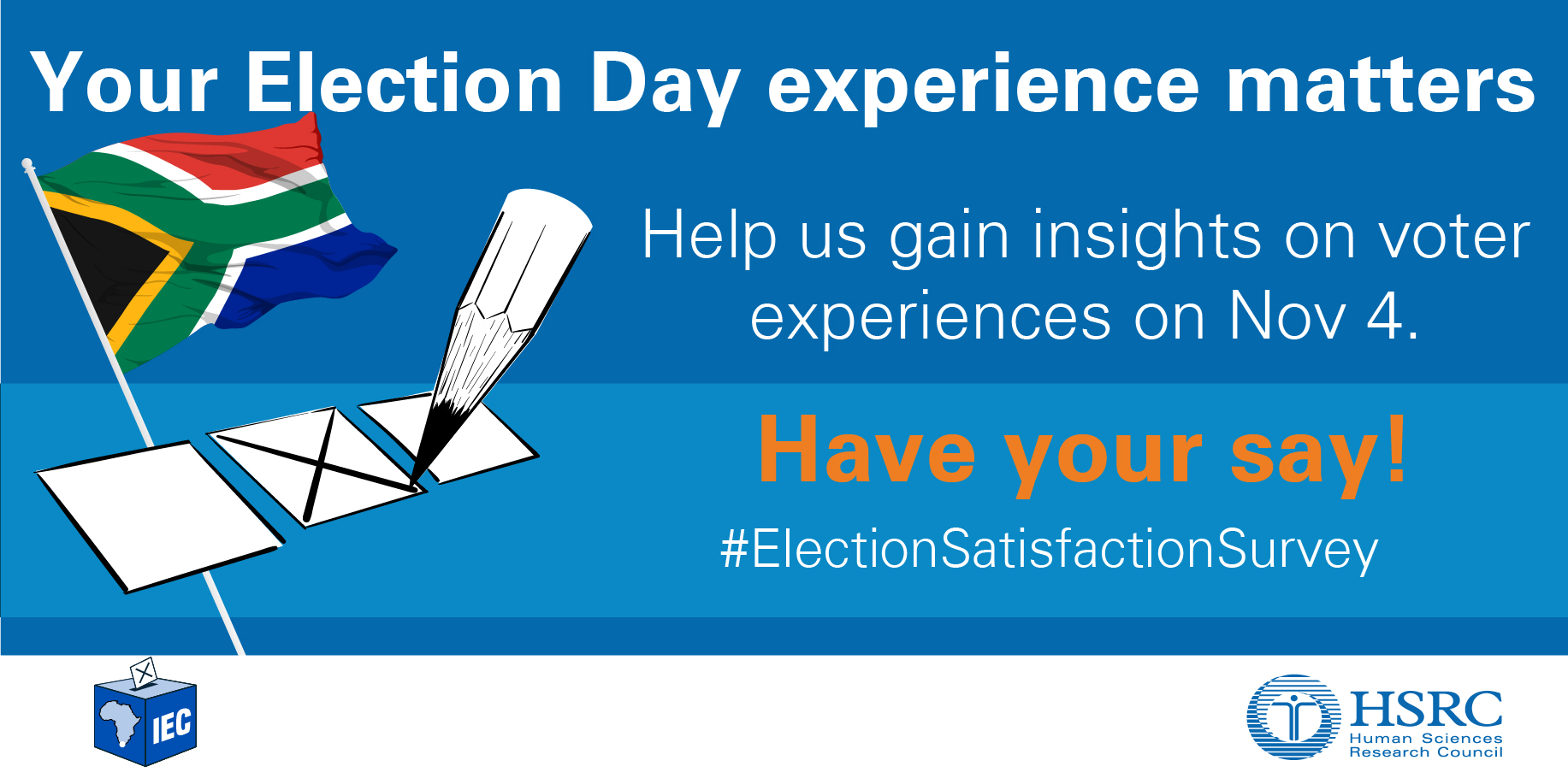
As South Africans head to the voting stations this Election Day, 4 November, casting your vote is only part of the democratic story. At select voting stations across the country, voters will have the opportunity to participate in the Election Satisfaction Survey (ESS)—a vital project that captures public feedback to safeguard the integrity and efficiency of the country’s elections.
The legacy of the project
- Long-standing partnership: The Electoral Commission of South Africa (IEC) has partnered with the Human Sciences Research Council (HSRC) since the late 1990s to gather empirical research on electoral democracy.
- Monitored over time: The ESS works in tandem with the pre-election Voter Participation Survey (VPS). Both survey series have been conducted across national, provincial, and municipal elections for over a decade to track voter trends, public trust, and institutional performance over time.
What the survey aims to achieve
- Evaluating freeness and fairness: The primary objective of the ESS is to determine voters’ perceptions of whether the election procedures were free and fair.
- Assessing operational efficiency: The study evaluates the management performance of the IEC and rates the conduct, impartiality, and helpfulness of voting station officials.
- Measuring the voter experience: It gathers feedback on key operational aspects, including queue waiting times, ballot paper clarity, secrecy of the vote, and accessibility for the elderly, pregnant voters, and persons with disabilities.
- Rapid evidence for declaration and future planning: Survey findings are compiled quickly—typically within 48 hours of Election Day—to provide evidence supporting the IEC’s official declaration of the election, as well as to guide operational improvements for future polls.
On Election Day: What you need to know
- Nationwide sample: The survey is conducted across a nationally representative sample of 300 voting stations selected proportionally across all nine provinces based on registered voter distribution and demographic factors.
- Random voter selection: At each selected station, fieldworkers randomly invite voters across four distinct time slots throughout the day, targeting 50 voters per station (aiming for roughly 15,000 total respondents).
- Identifying fieldworkers: HSRC data collectors are easily identifiable at voting stations by their HSRC-marked bibs and official identity cards.
- Survey process: Fieldworkers will introduce themselves, explain the purpose of the research, obtain your voluntary consent, and record responses on digital handheld devices using Computer-Assisted Personal Interviewing (CAPI).
For more information about this Local Government Elections, visit the official IEC website here.