

Traditional knowledge is often assumed to be distinct from modern science, and part of a fading cultural legacy. Data from the HSRC’s 2022 South African Public Relationship with Science Survey fundamentally challenge this assumption. South Africans, particularly young and educated black South Africans, do not see traditional and modern science as opposites, but hold both worldviews simultaneously. This Heritage Month, the data tells a story worth celebrating.
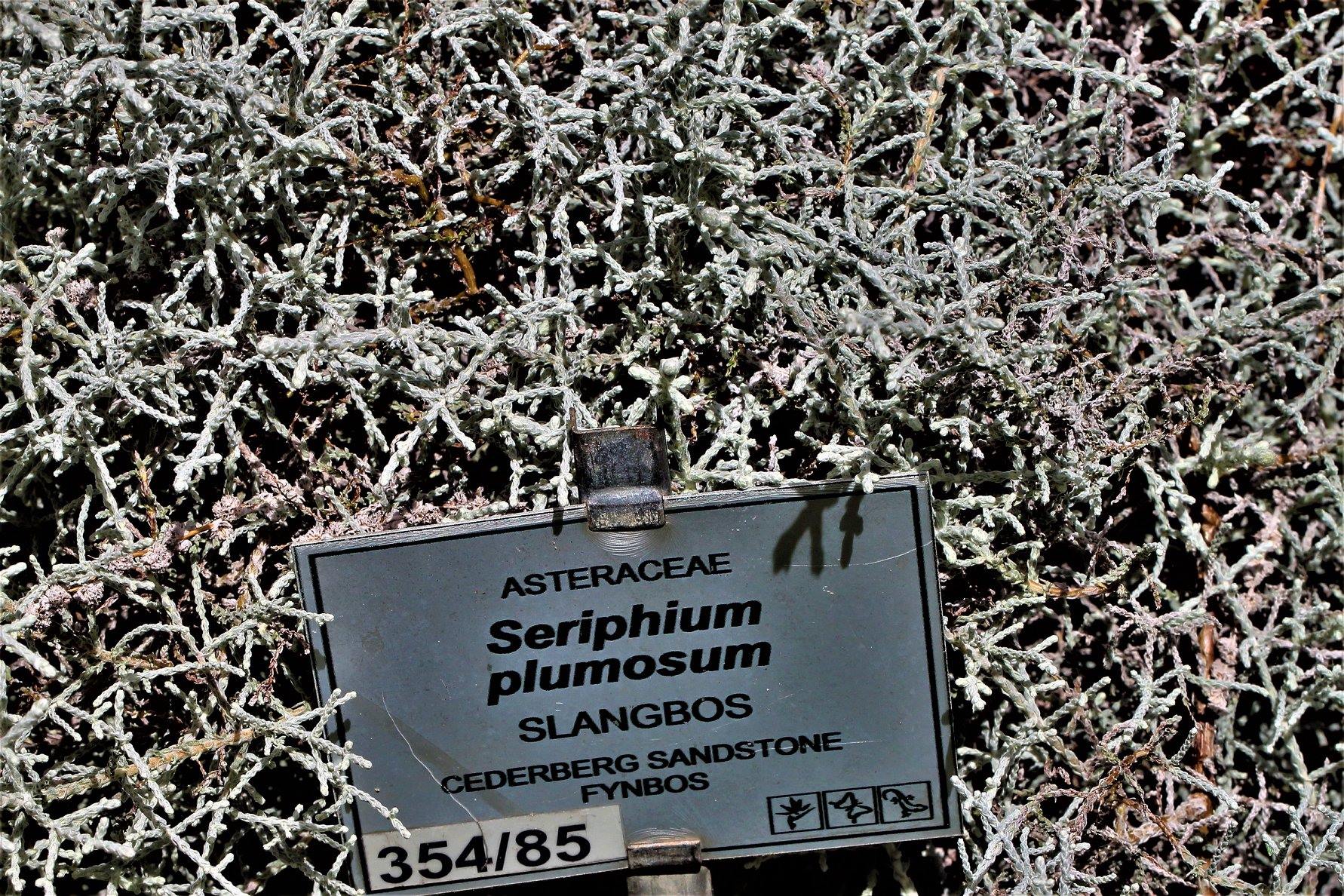
Slangbos (Seriphium plumosum), a plant used in South African traditional medicine, photographed at Kirstenbosch National Botanical Garden, 2020. Photo: Kgara Kevin Rack, Wikimedia Commons
Ask young South Africans about their heritage, and their responses may include traditional home remedies passed down through generations as much as a reliance on modern medicine. The recognition and integration of multiple worldviews extend from modern medicine to cultural pride in traditional song and support for the Springboks or Banyana Banyana. Before the popularisation of modern science, communities at the southern tip of Africa developed rich and sophisticated systems for surviving, adapting and thriving within their environments.
These traditional science and technology (S&T) systems are dynamic and evolving bodies of knowledge that are continually tested, verified and refined through close interaction with the natural environment in fields such as agriculture, medicine, climate and natural resource management. This knowledge has supported human development and provided solutions to contemporary social challenges, enabling indigenous populations to live sustainably within their ecosystems for centuries, often long before modern science began documenting and engaging with these communities and practices.
However, traditional knowledge is at times seen as a waning tradition, acknowledged and preserved by only older, rural or less formally educated populations.
The HSRC’s 2022 South African Public Relationship with Science (SAPRS) Survey explored the public’s relationship with traditional S&T among a representative national sample of 5 960 South Africans. The SAPRS Survey defined traditional knowledge ‘as knowledge and skills that have been passed on from generation to generation within a community’. Drawing on the survey data, this piece examines the public’s relationship with traditional S&T, with a particular focus on the black South African population group.
South Africans’ knowledge and attitudes towards traditional S&T
At the national level, around two-thirds of South Africans were at least ‘somewhat knowledgeable’ (62%) and ‘interested’ (68%) in traditional S&T. When examining attitudes related to the benefits (promise) of traditional S&T, the picture was more nuanced (Figure 1). South Africans reported moderately positive views, particularly in relation to the role of traditional S&T in quality of life and agriculture. However, they were more reserved about the roles of traditional medicine and healers. Reservation here should not be conflated with a rejection of traditional scientific knowledge.
Figure 1. Views of promise (P) and reservation (R), 2022
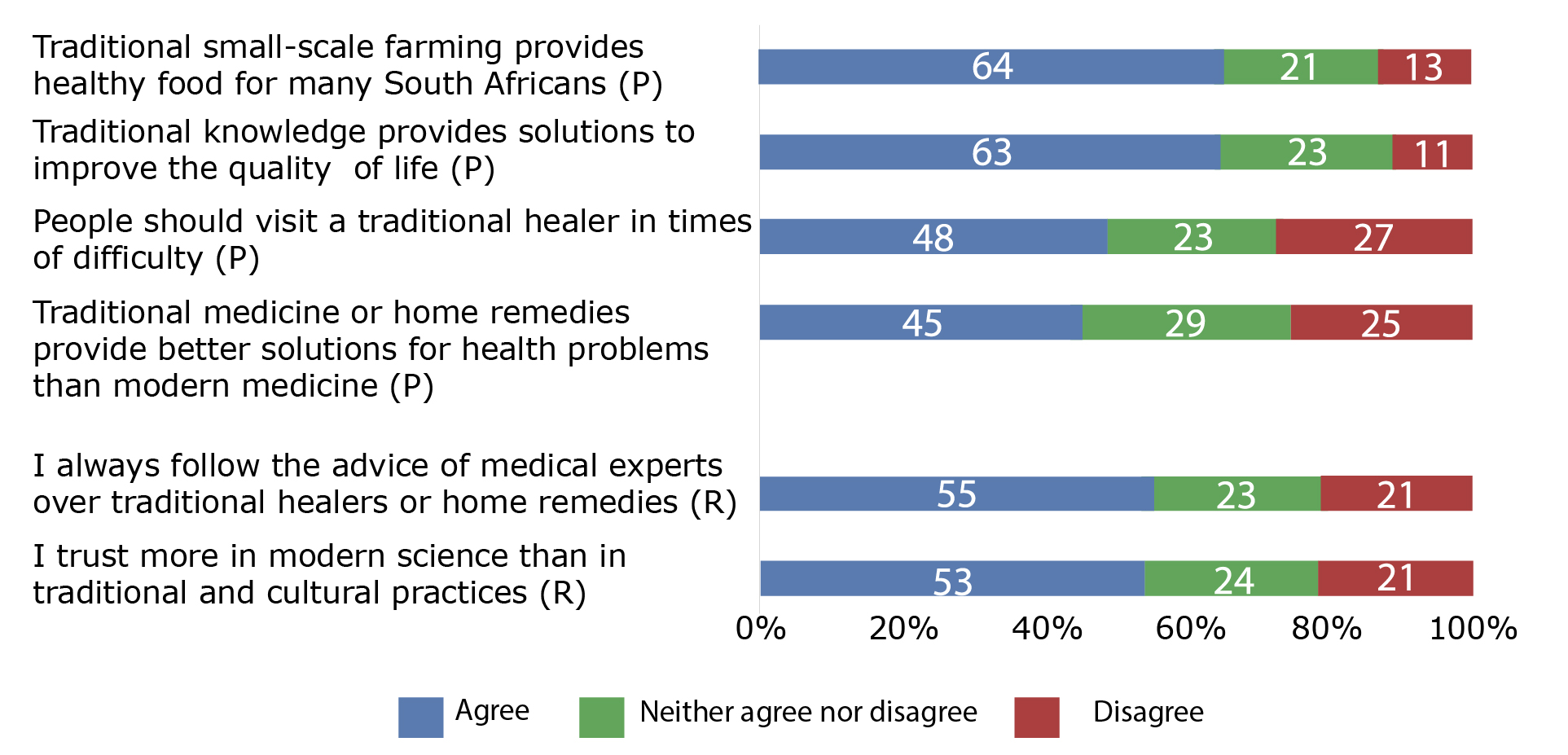
Source: HSRC SAPRS Survey 2022 (All South Africans n=5 960)
Views differed by socio-demographic characteristics
The survey revealed that recognition of the positive value of traditional S&T (promise) varied across socio-demographic groups. More positive views were found among individuals with Tshivenda, isiZulu or Xitsonga as a home language, those aged between 16 and 24 years, those who had lower formal educational attainment, those who came from a lower socioeconomic status, and those who lived in rural areas. This pattern remained consistent, from ‘knowledge’ to ‘interest’, highlighting the influence of formal education on attitudes, while active knowledge-seeking behaviours remained focused among the younger and more educated South Africans.
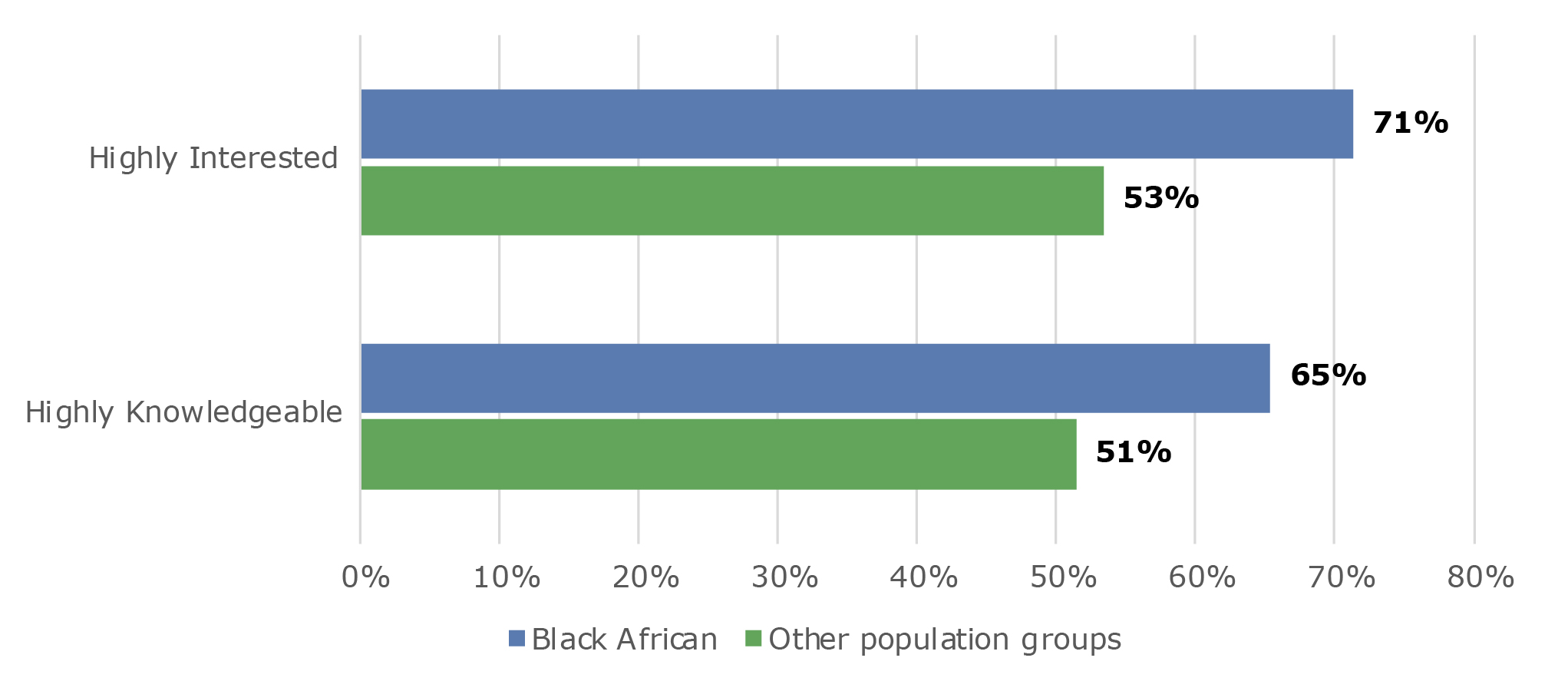
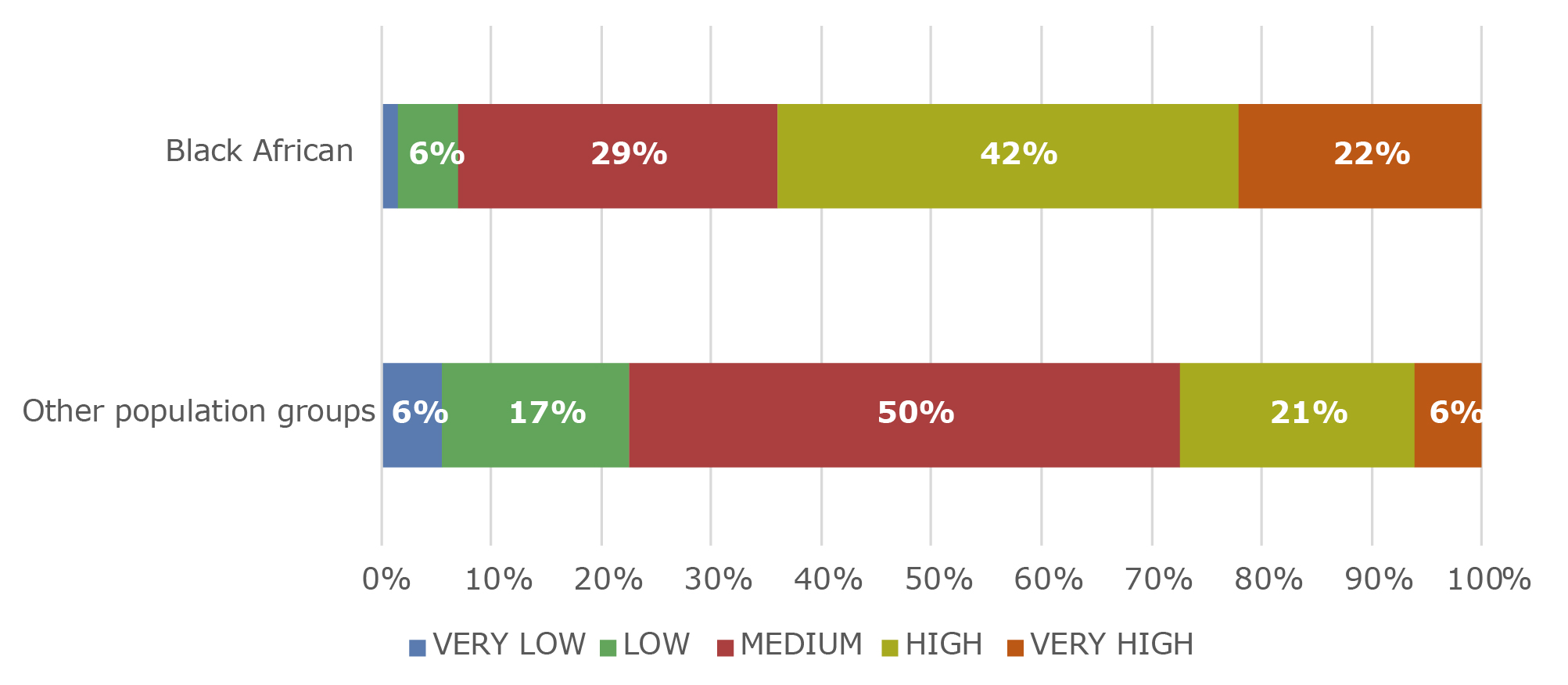
When looking at the population group data, black South African adults reported 15–20% higher knowledge and interest in traditional S&T than other population groups (Figure 2). Moreover, this group showed notably higher promise attitudes (Figure 3). As this group comprises approximately 82% of the South African population, we explore their relationship with traditional S&T in more detail. This focus reflects the demographic group’s weight in the data, and not an assumption that engagement with traditional S&T is unique to this population group. Intriguingly, the data also indicates a high degree of knowledge and interest among other population groups in areas of traditional S&T.
Figure 2. Knowledge and interest in traditional S&T, 2022
Source: HSRC SAPRS Survey 2022
Figure 3. Index of promise of traditional S&T, 2022
Source: HSRC SAPRS Survey 2022
How do black South Africans relate to traditional S&T?
Younger and more educated black individuals embraced a ‘dual framework’, viewing traditional and modern science as complementary systems addressing contemporary challenges. This represents an important opportunity to leverage interest and engagement with traditional S&T.
Younger black South Africans demonstrated the highest levels of both knowledge and interest, with interest being consistently higher, highlighting an unmet desire for traditional S&T information and engagement. Younger generations often champion the philosophical, agricultural and intellectual value of indigenous knowledge systems, while utilising modern healthcare systems.
Within this demographic, interest and knowledge increased with formal educational attainment, with the highest levels amongst university graduates. The data showed that more educated black South Africans are reframing traditional S&T as a valuable knowledge system alongside modern science. Traditional small-scale farming is widely supported across groups, being largely immune to the educational and generational disparities in other findings.
While interest and knowledge were higher among those who self-identified as ‘non-poor’ (on a subjective poverty scale), reliance on traditional healers and home remedies increased among those identifying as poor. Therefore, although many black South Africans expressed knowledge and interest in traditional S&T, it became a more practically relied-upon resource within poorer households. This is supported by literature showing that many South Africans rely on traditional medicine, due to factors such as affordability, accessibility and social context.
Geographic location did not reveal significant differences between urban formal and rural residents. However, consistent with the reality of informal settlements, where traditional remedies are often a more immediate and practical alternative to formal medicine, residents were more reliant on traditional healers and medicine.
Modern and traditional S&T as dual knowledge systems
One of the most important findings is that black South Africans, particularly those who are younger and more educated, recognised the benefits of both modern and traditional S&T. The finding suggests that traditional and modern knowledge systems are not always in conflict but often coexist in daily life, establishing a dual framework of complementary rather than incompatible knowledge systems.
Promoting traditional S&T in South Africa
There is an opportunity to frame traditional S&T as an important complementary knowledge system and to integrate it with modern S&T in South Africa. This is particularly important among individuals with existing knowledge, interest and supportive attitudes that can strengthen the recognition and relevance of traditional S&T. We suggest the following to enhance the position of traditional S&T in South Africa:
- Highlight the complementarity of traditional and modern S&T: Segments of the public recognise the complementary nature of modern and traditional S&T. Science communication must therefore move away from a binary ‘modern vs traditional’ framing of S&T to a more integrative approach.
- Target groups supporting traditional S&T: Focus on young, educated black South Africans and those in urban areas that recognise the dual S&T systems, as they have the capacity to advocate for the integration of traditional S&T into education, research and policy.
- Increase knowledge, interest and support: Targeted strategies are needed to promote traditional S&T among groups with lower knowledge, interest and appreciation, including those who are older, with lower formal education and are living in rural areas, and other population groups.
- Address the knowledge–interest gap: As interest was generally higher than knowledge, there is an opportunity to produce credible content that explains and promotes the role of traditional S&T through channels such as digital media, public campaigns and educational curricula.
- Profile examples of real-world integration: Initiatives that illustrate the connection between traditional and modern S&T should be showcased, such as the work of Prof. Motlalepula Matsabisa at the University of the Free State, which bridges indigenous knowledge systems and rigorous clinical science.
This Heritage Month, the SAPRS Survey findings offer something worth celebrating. Traditional knowledge, medicine and practices are not fading away, but are being celebrated, reinforced and adopted, especially by younger generations. More importantly, this body of knowledge is actively being expanded and integrated with modern practices. The benefits are not limited to one group but are accessible to all South Africans. Like modern S&T, traditional knowledge can be subjected to rigorous testing, research and development, and commercialisation to yield valuable context-informed products, services and community benefits. These benefits and opportunities should be better understood to ensure communities are acknowledged in the process of traditional S&T discovery and validation. As young South Africans increasingly show us, heritage and progress are not opposing forces; they are more often held in the same hand, charting the path forward.
Authors and acknowledgements
This article was written by Dr Saahier Parker (senior research specialist), Sylvia Hannan (chief researcher) and Dr Thando Tenza (chief researcher), all from the HSRC’s Equitable Education and Economies (EEE) division. It is based on findings from the 2022 SAPRS Survey, which was funded by the Department of Science, Technology and Innovation.
For more information, please contact Parker (sparker@hsrc.ac.za), Hannan (shannan@hsrc.ac.za) or Tenza (ttenza@hsrc.ac.za).
Over the course of four years, the core research team members on the SAPRS Survey project were Dr Vijay Reddy, Dr Benjamin Roberts, Sylvia Hannan and Dr Steven Gordon. Researchers who contributed to aspects of the study were Dr Thando Tenza, Dr Shanaaz Dunn, Dr Ngqapheli Mchunu, Dr Thobeka Zondi, Fabian Arends and Dr Saahier Parker.