

Drought is recognised as an environmental and agricultural crisis, but an HSRC-led study in Muyexe Village, Limpopo, revealed far broader impacts. It affects health, education, household income and access to food and water, with children, older people and poorer households carrying the greatest burden. The study showed how the Muyexe community has adapted to these challenges, and suggested ways in which it can be supported going forward.
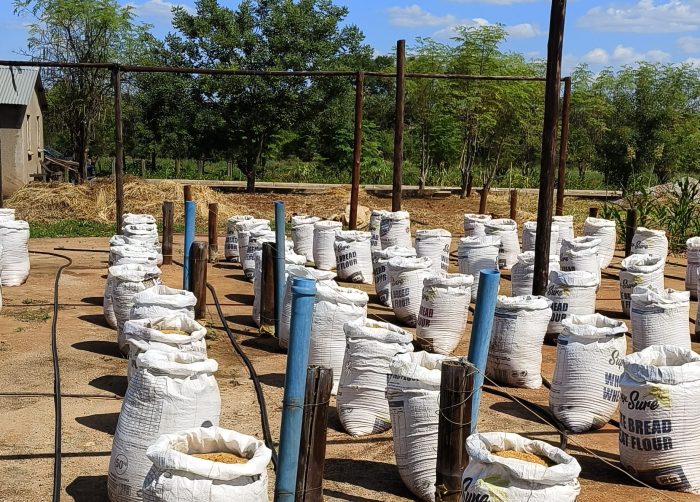
Growing crops in bags means water used is isolated to the bag and not dispersed into the ground, allowing less water to be lost, Muyexe Village, Limpopo, 2024. Photo: HSRC
Climate change is reshaping people’s lives through rising temperatures, unpredictable rainfall and increasingly severe weather-related hazards. Drought is particularly difficult to manage because it develops slowly, with effects accumulating as water sources dry up, crops fail, livestock decline and households exhaust their savings and other resources. These pressures are especially severe in communities that already face poverty, unemployment and inadequate public services.
An HSRC-led study found that beyond the direct environmental and agricultural effects, drought intensifies socio-economic vulnerability and undermines public health. Conducted in collaboration with the University of KwaZulu-Natal, the study aimed to identify the direct and indirect impacts of prolonged and recurring drought on Muyexe Village in Limpopo, South Africa’s northernmost province.
The study focused on examining socio-economic and health challenges, and documenting community-based coping and adaptation strategies. Data were collected between February–March 2024, through focus groups with community members in Muyexe Village as well as interviews with individuals representing local government, healthcare, traditional leadership and community structures.
A village shaped by scarcity
Muyexe is a rural village in the Greater Giyani Municipality, approximately 35 km east of Giyani and close to the Kruger National Park. Its population of about 15 000 residents is exposed to a hot, semi-arid climate, with recurring droughts, high temperatures and unreliable rainfall.
In 2009, Muyexe was selected as the first pilot site for the Comprehensive Rural Development Programme, a government initiative to address poverty and food insecurity, improve standards of living, rectify past injustices and create economic opportunities.
Although the programme made progress in delivering houses and sanitation facilities, many households in Muyexe still lack piped water and depend on boreholes, rainwater harvesting, seasonal surface water or distant communal taps. These water sources often became unreliable during droughts. The area also faces high unemployment and infrastructure limitations, leaving households with few resources to absorb climate-related shocks.
When drought becomes part of daily life
The study identified children and elders as the most affected groups in the Muyexe community, because of their specific vulnerabilities. “Children skip school because there is no water for bathing,” one interviewee explained, while focus group participants highlighted the difficulties of washing school uniforms. Water shortages may therefore affect long-term educational outcomes, inhibiting economic opportunities.
“The elders are most affected because they are the ones involved in farming; so drought affects their daily lives,” expressed another focus group. Apart from needing water for crops and livestock, the elders use it for cooking and washing, yet their limited mobility – combined with the risks imposed by heat exposure, dehydration and existing chronic illnesses – make it difficult for some to walk long distances to collect water. Women and younger family members must often take on the additional work of collecting water and caring for children and older relatives.
The study participants recognised that scarce or unsafe water could lead to diarrhoea, cholera and other illnesses. They also described headaches, fainting, skin problems, and complications among people living with hypertension or diabetes during periods of extreme heat and water scarcity. Chronic patients were deemed particularly vulnerable when clinics lacked the resources to respond to heat-related illness, dehydration and disease outbreaks.
Drought also exacts a heavy emotional and psychological burden. Stress resulting from the loss of livestock and crops contributes to mental health challenges such as anxiety and depression, particularly among older people, and may exacerbate other health conditions.
Hunger, job losses and widening inequality
Reduced agricultural production during drought means households have less food to eat or sell. At the same time, food prices rise and families become increasingly dependent on social grants as job losses occur. One farm, for example, reduced its workforce from 36 people to 12 due to drought.
Crucially, drought did not affect everyone equally but intensified existing inequalities. Those with stable salaries, including teachers, nurses and police officers, were better able to cope than people dependent on agriculture, informal work or grants.
Communities adapt, but cannot do it alone
Muyexe residents developed practical ways of coping. Some sold livestock to buy food, preserved maize and seeds for future planting, sought part-time employment, or used weather information from radio, television, mobile phones and community social-media groups to inform farming practices.
Residents also adopted water-efficient cultivation methods, such as bag gardening (growing crops in large sacks or bags filled with soil instead of planting directly in the ground) and controlled nursery propagation (growing out seedlings in a small, managed space before transplanting them into the fields). These methods allowed households to use smaller quantities of water, reduce crop losses and continue producing some food during dry periods.
However, all focus group participants reported that they had received no formal climate-change adaptation training. This is a critical gap, given that general weather information does not provide the local, practical guidance communities need to protect their health, water supplies and livelihoods.
Turning evidence into action
The study findings suggest that Muyexe and other drought-prone areas need urgent investment in boreholes, rainwater-harvesting systems, small-scale irrigation and other reliable water infrastructure. Local health systems should be improved to provide interventions during droughts and heatwaves, including mobile clinic services, mental-health support, and better care for chronic patients. Early-warning mechanisms for climate-sensitive diseases, stronger disease surveillance, and better use of climate information when planning staff, medication and other resources are also needed.
Climate education in schools as well as practical community training could help residents prepare before conditions reach crisis levels. These initiatives should ideally integrate local and traditional knowledge about water conservation, drought forecasting, food production and health.
Most importantly, government departments should not treat water, agriculture, health and social protection as separate concerns. Multi-layered, coordinated interventions are essential to effectively mitigate the far-reaching impacts of drought on rural communities like Muyexe.
Research contacts and acknowledgements
This Review article was written by HSRC science writer Jessie-Lee Smith with Caiphus Baloyi (PhD research trainee) and Dr Wilfred Lunga (chief research specialist) from the HSRC’s Developmental, Capable and Ethical State. It is based on the paper Surviving the dry spell: socio-economic, health, and adaptive challenges of drought in Muyexe Village, South Africa by Baloyi, Lunga and Dr Moya Bydawell from the University of KwaZulu-Natal’s College of Humanities.
For more information, please contact Baloyi at cbaloyi@hsrc.ac.za.