

Poverty, unemployment, political instability, economic shocks, violence, climate change and educational disruption are usually treated as separate problems, rarely for their compounding, collective impact. HSRC researchers explored this through a qualitative sub-study of 40 young people, nested within Asenze – a longitudinal study that has tracked a KwaZulu-Natal cohort from childhood to adulthood since 2008. Entering adulthood, this group was hit by three successive crises from 2020. What determined whether they overcame them, the study found, was not material resources but identity resources: agency, belonging, self-worth, purpose and the capacity to aspire.
Photo: Mikhail Nilov, Pexels
Between 2020 and 2022, young people in the Valley of 1000 Hills in KwaZulu-Natal (KZN) endured three nationally declared states of emergency: the COVID-19 pandemic, which disrupted schools and livelihoods; the July 2021 social unrest or ‘looting’, which had severe consequences for local communities, businesses and the broader economy; and the devastating floods of April 2022, which followed the heaviest seasonal downpour that KZN had seen in over 60 years. Collectively, these shocks threatened residents’ livelihoods and took a heavy toll on mental well-being.
The HSRC conducted a qualitative study (2024–2026) with 40 young people and 20 of their caregivers to understand the impact of these compound crises on their lives and mental health. Interviewed in 2025, aged between 19 and 23, the young people reflected on the shocks they had experienced between grades 9 and 12. Researchers wanted to know why some maintained their mental health, well-being and resilience better than others and found that the richness of the participants’ inner worlds played a significant role.
Navigating polycrisis
At the start of lockdown, many participants were in high school and endured an abrupt shift to hybrid learning and self-study. Limited digital access and inadequate contact with teachers made it hard to keep learning while schools stayed closed:
“Like everything changed. I had to adjust to new way of doing things … studying by myself without having help from the teacher. I know that I am an audio learner … I understand better if something is explained to me. We were crowded at home because everyone had stopped working … I did not maintain my pass mark.”
– Asanda (20)
Then came the looting and chaos of July 2021, which made it hard for many to find food and essentials:
“I remember that time. Bread prices had increased to R30 from about R23; it affected my family and me too because we were struggling. We are not a wealthy family – we’re just surviving with whatever we get. So, when the price of food increased, that made me feel like, ‘What if today maybe we are not going to eat.’ My mom is the only provider in my family. We are a family of seven.”
– Sipho (22)
Distrust in communities grew, and when tensions boiled over, they spilled into violence. Thabani (22) described this period feeling “as if apartheid was returning; a lot of things happened.”
In 2022, their community was underwater, with homes washed away, community roads collapsing, and farmlands damaged:
“The house we lived in was blown away. So, we moved and built a shack where we temporarily lived … We lived there until December. It did damage and even damaged our neighbours’ house.”
– Thabani (22)
Collectively, these events threatened livelihoods and the psychological well-being of the young people. Yet the intensity with which individuals experienced each crisis differed. Some were able to maintain their mental health better than others. The HSRC found that those who upheld a sense of self-worth, purpose, belonging and agency – so-called ‘identity resources’ – sustained their psychological well-being better throughout.
Purpose
Young people who maintained aspiration and hope for a better future, describing themselves as “go-getters” who could beat the odds, continued to “fight for their futures” despite hardships. They navigated each crisis with greater resilience:
“[The crises] taught me a lot … how to arrange my affairs properly … stand up for myself … know myself and where I would like to go.”
– Athi (early twenties)
Participants without this sense of purpose – most often those not in employment, education, or training (NEET) – described feeling “stuck”, “stagnant”, and increasingly diminished as the crises compounded:
“You see, it seems like my life is stagnant. [Because] at the time I am sitting and not studying …”
– Athambile (21)
“I feel drained. People put pressure on you, especially because I’m at home and not in school … like it’s my choice … the way people talk makes me feel bad.” (20)
– Nothemba
Without purpose, hopelessness proliferates, and resilience dwindles. In unequal societies, where material resources are unevenly distributed and so many are trapped in poverty, aspiration is not only a luxury; it is a survival strategy.
Belonging
A sense of belonging to formal or peer groups, churches, and family and community networks fortified some young people against the full force of each crisis, providing socio-emotional scaffolding. Churches, in particular, were frequently described as vital sites of psychosocial support:
“[Church] is a place I love because I am free when I am there … we meet up with other people, and we’re able to chat, because we may ultimately share knowledge and contribute to each other’s growth on other matters.”
“Church is the one place where I feel at peace. People don’t pressure or judge me … Our youth leader always encourages us and gives supportive talks. That helps me positively.”
Young people with stronger connections to such systems felt less isolated. Those with weaker connections were more likely to report isolation; young men, in particular, were most affected.
Agency
Agency shaped how young people responded to instability. Agency, or the “navigational capacity to act on your own” as HSRC sociologist Sharlene Swartz describes it, converts purpose to action and helps sustain belonging. Without it, even those with a strong sense of purpose and belonging can become paralysed by circumstance. Participants with a greater sense of agency, despite ongoing disruptions and uncertainty, could still imagine their future selves as better off, and worked towards that future by hustling, searching for employment, creating informal livelihoods and pursuing learning opportunities:
“Because I try everything to make a living … I want to do it myself because I see that it’s tough. My mom isn’t employed, and she can’t afford to send me to school, so I need to make a plan. That’s why I do online surveys, use different apps, and am part of stokvels.”
– Nothemba
“I want to become something so that people see me, not the way they see me now. I still want to rebuild the house that collapsed because of the floods. I want the space to be restored to how it was before.”
– Akho
Crucially, agency is particularly vulnerable to structural inequality. Its uneven distribution across participants – shaped by gender, class, educational access, networks and geography – illustrates the dependence of this resource on social enablers. Young people cannot act on their own circumstances if they lack the means to do so.
Conclusion
Collectively, purpose, belonging and agency are resources central to young people’s psychological well-being amid compounding crises. They are essential to building a positive, coherent self-identity, which acts as a psychological buffer against negative risk-taking. This was best illustrated by NEET participants, who, in the absence of institutions or communities actively reaffirming their value, struggled most to navigate each crisis.
Participants who felt seen and connected, through stronger ties to support systems, fared better. Fortunately, these identity resources are shaped not only by material resources but also, perhaps fundamentally, by the quality of young people’s relationships and the environments in which they live. Where crises compound, the question is whether young people survive them materially, and whether they emerge still believing they are worthy of a future. Much of that rests on whether society actively affirms their worth. Feeling seen and valued offers real psychological protection, and while crises remain disruptive, they are not as devastating as they would be otherwise.
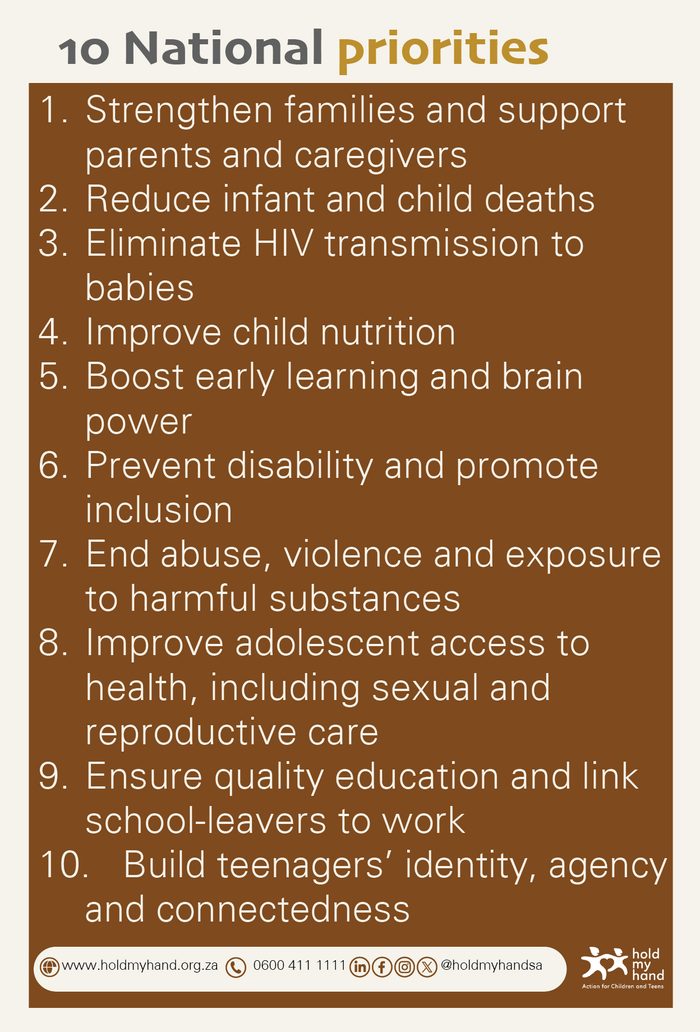
South Africa cannot foster social cohesion or economic recovery while millions of young citizens feel unseen, stuck or disposable. The National Strategy to Accelerate Action for Children (NSAAC) [AO1] recognises this, calling for a whole-of-society approach to child and adolescent well-being, with one of its 10 national priorities focused on adolescent identity, agency and connectedness.
The Hold My Hand Accelerator for Children and Teens – a public-private collaboration between the DG Murray Trust and the Presidency – is driving this priority forward. Protecting and valuing adolescent identity, as well as encouraging the resources that build a positive self-concept, are the work of all of society. Identity is the foundation on which development is built for the individual and the nation.
Research contacts and acknowledgements
This Review article was written by Dr Alude Mahali, a research director in the HSRC’s Equitable Education and Economies (EEE) research division, with input from Abigail Wood, coordinator of communications, research and networking at the Hold My Hand Accelerator for Children and Teens. For more information about this work, please contact Mahali at amahali@hsrc.ac.za.
The project research team included Mahali (EEE), as well as Drs Kombi Sausi and Ntombizodumo Mkwanazi from the HSRC’s Developmental, Capable and Ethical State research division. Appreciation must also be extended to the University of KwaZulu-Natal Asenze study team for their foundational support and guidance: Prof. Chris Desmond, Kathryn Watt and Furzana Timol.
This study was funded by the United States National Institute of Mental Health under award number RF1MH134561. The content is solely the responsibility of the authors and does not necessarily represent the official views of the National Institutes of Health.