


While social integration enables immigrants to participate in community life, it does not necessarily guarantee their acceptance within host communities. Neighbourhood acceptance or rejection emerges when locals don’t feel comfortable with their immigrant neighbours. A recent study by the HSRC highlights suspicion of African immigrants by South Africans and vice versa because of the prejudices they hold about one another in the neighbourhoods in which they live and work.
The social integration of immigrants is a major priority for African governments and globally. Promoting the social integration of immigrants aligns with Sustainable Development Goal 16, which seeks to foster peaceful, just and inclusive societies. It speaks to target 16.10, which focuses on ‘ensuring public access to information and protecting fundamental freedoms in accordance with national legislation and international agreements’. However, despite the stipulations of Sustainable Development Goals 16 and 16.10, relations between locals and immigrants are at times not always cordial, leading to suspicion and tension.
An HSRC study found that mutual suspicion and prejudice continue to undermine neighbourhood relations between South Africans and African immigrants despite their living and working together. The study aimed to assess residents’ baseline levels of satisfaction with their neighbours and neighbourhoods by focusing on safety, trust, social problems and access to local government basic services, as well as to pilot a civic innovation based on the Know Your Neighbour strategy for improving social cohesion among South Africans and immigrants.
Researchers collected data through dialogues conducted in three areas with a high concentration of South Africans and immigrants living and working together as neighbours. Two of the areas were urban (Arcadia, Pretoria, and Yeoville, Johannesburg) and one informal (Plastic City, Pretoria East). Each dialogue consisted of 30 participants, including community leaders, local South Africans, immigrants and representatives of community organisations.
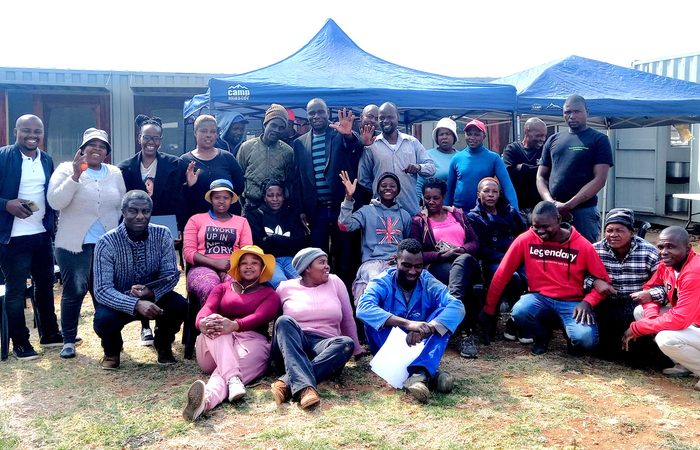
Group picture at data collection dialogue, Plastic City, Pretoria East, Gauteng. Photo: Dr Mathias Alubafi Fubah, HSRC, July 2022
Social integration in the study is presented as an important enabler of social cohesion, especially in host communities and countries in sub-Saharan Africa that receive large numbers of immigrants. This is because social integration of immigrants and migrants allowed them to have and enjoy benefits that unintegrated individuals or persons do not have. Research suggests that, when insufficient or ineffective efforts are made to ensure social integration, newcomers can become marginalised and thus are more vulnerable to risk of all kinds, including lack of educational opportunities, language barriers and inability to secure decent work. Group picture at data collection dialogue, Plastic City, Pretoria East, Gauteng
South Africans and African immigrants as neighbours in the neighbourhoods
Most participants noted that, regardless of the nature of relationships between South Africans and their immigrant neighbours, and vice versa, the two groups live in suspicion of each other because of the prejudices that they hold about one another. According to one of the participants:
‘Not all immigrants are bad. Immigrants from certain African countries are good because they don’t commit the type of crimes that immigrants from neighbouring countries commit in South Africa. But it becomes difficult to determine if an immigrant is good or bad when he or she is undocumented. Such immigrants are automatically considered as criminals no matter what effort they put to prove their innocence. This is a challenge to living and working as neighbours in neighbourhoods.’
Most immigrant participants felt that local South Africans targeted them because they saw them as criminals, and that is why there was no trust between the two groups. As one of the participants noted:
‘I don’t trust my South African neighbours because of the impression most of them have about us. My two neighbours are South Africans, but we don’t know each other as Africans would normally do towards a fellow African. They speak their local language to me whenever we meet, even though they know that I am a foreigner and don’t understand. This is one way of exposing me because when I don’t understand, their fellow brothers or friends will start asking: ‘Is he a kwere kwere?’ Once they realise that you are a foreigner, you become an easy target. They will demand things from you and when you fail to give, they will torment and can even rob you.’
The study found that African immigrants were a ‘soft target’ for gangs because of the suspicion about them, and that immigrants were vulnerable because they lacked connections to others in the community, and so there would not be as many repercussions for the perpetrators of the violence against them. Other works similarly found that in the Delft South area in Cape Town, only those immigrant shopkeepers with strong linkages and/or community support had avoided crime.
Additionally, some of the participants noted that local South Africans had many ways of victimising them the moment they discovered that they were foreigners. Some would simply ‘set you up’, according to some participants, and if you didn’t end up in the hands of the police, you would be robbed.
Most of the immigrant participants living in the informal settlement did not speak English (some spoke Portuguese and others Lingala) and, as a result, were isolated and treated differently by local South Africans and neighbours. For example, one of the participants narrated how she could not receive assistance from a neighbouring clinic because she could not speak English at the time and was easily identified as a foreigner, and nurses did not see any reason to assist her.
According to one of the respondents:
‘Speaking the same or a similar language with your South African neighbour in the neighbourhood does not mean that you are safe. Some of us Zimbabweans speak Ndebele just like some local South Africans, but the accent is different. So, when you speak for the first time, South Africans may think that you are one of them and will be friendly but as time goes on, they will discover that you are a foreigner and their attitude towards you will start changing.’
The study further found that some local South Africans made impromptu visits to neighbourhoods hosting immigrants to ascertain if the immigrants owned the houses they were living in or renting. In the dialogue in Yeoville, for example, one of the participants noted that he was unexpectedly visited by a group of three South African men who wanted to know if he had documents and if he owned the property he was living in. When he presented his documents, they left, promising to return to check that everyone living in the house was documented. This suggests that some South Africans feel comfortable living with immigrant neighbours who are documented or legally in the country and neighbourhoods.
Towards ensuring effective social integration of immigrants
The study highlighted the need to ensure effective social integration that allows South Africans and African immigrants to live comfortably as neighbours, without being suspicious of one another. Discussions were enriching and, in some areas, such as Yeoville and Plastic City, the ward councillors and some participants requested that such dialogues be organised frequently because they contributed towards social integration through the recommendations that they generated from both local South Africans and immigrants. Major recommendations included the following:
- Legal documentation of immigrants to ensure they can be traced and accounted for when the need arises
- Awareness creation to address the issue of prejudices and suspicion held by local South Africans and immigrants about each other
- Establishment of a ‘know your neighbour’ campaign to promote living together by locals and immigrants as neighbours in neighbourhoods
- Promotion of social security and justice for local South Africans and immigrants
- Prioritisation of South African citizens in terms of service delivery, among others
While acting on these recommendations could contribute greatly to enhancing a sense of living and working together among South Africans and immigrants as neighbours, we recognise that maintaining an appropriate balance depends on many factors that vary across time and place. Dealing with this requires regularising the legal status of African immigrants to ensure that their South African neighbours see them as people who are legally in the country and neighbourhoods rather than illegal or undocumented immigrants.
Research contact and acknowledgement
This Review article was written by Dr Mathias Alubafi Fubah (senior research specialist at the HSRC’s Developmental, Capable and Ethical State division) and Ms Kegomoditswe Mamabolo (Department of Science, Technology and Innovation–HSRC intern), with inputs from HSRC science writer Jessie-Lee Smith.
It was based on the book chapter ‘Local South Africans and immigrants as neighbours in the neighbourhoods’, published in the book Social Integration of Immigrants in Sub-Saharan African Communities: Challenges and Prospects (African Sun Media, 2026). For more information, contact Dr Mathias Alubafi Fubah at malubafi@hsrc.ac.za.
Collaborating researchers included Dr Isaac Kabelenga (University of Zambia) and Ms Dimpho Makitla (University of South Africa).
The study was funded by the HSRC.