

In short
- Youth aged 16–24 show the highest levels of academic science engagement, attraction-based participation and science information sharing.
- Young people are among the most active users of digital platforms, although significant digital inequalities remain.
- Community-based science engagement is relatively low across all age groups, indicating missed opportunities for public participation.
- Researchers recommend strengthening science education, expanding informal science activities and improving access to digital and community-based science engagement.
Public engagement with science and technology is essential for economic competitiveness, democratic participation and social cohesion. For youth in particular, meaningful science engagement provides the foundation for scientific literacy, informed citizenship and participation in knowledge economies. HSRC researchers draw on data from the 2022 South African Public Relationship with Science Survey to examine youth engagement with science and technology.

Photo: Mikhail Nilov, Pexels
The legacy of apartheid continues to shape educational and economic inequalities in South African society, including access to meaningful engagement with science and technology. Building a strong science culture among the public requires engaging citizens early in life. Understanding how science engagement varies by age is, therefore, both a research priority and a policy imperative.
Data from the HSRC’s 2022 South African Public Relationship with Science (SAPRS) Survey enable the examination of patterns of science engagement across generations. This article focuses on whether science engagement among youth aged 16–24 years approximates or differs from that of older South Africans and considers implications for building a more scientifically engaged young generation.
Youth engagement with science in South Africa
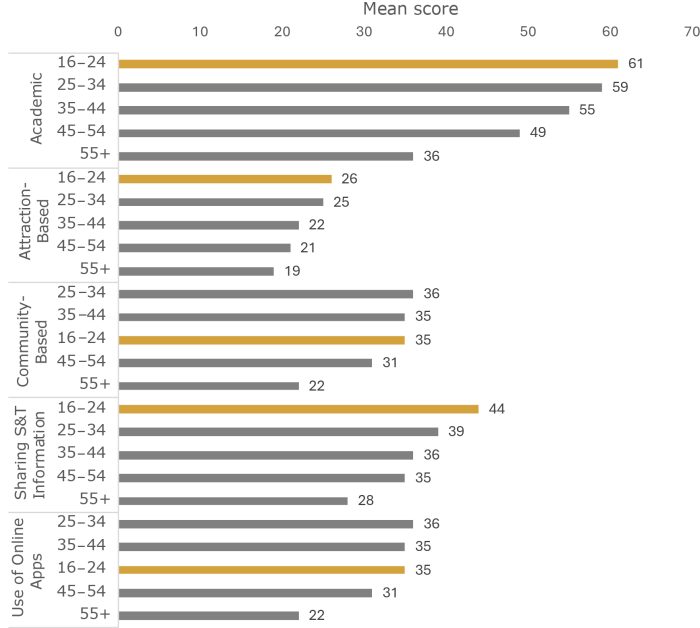
The SAPRS Survey measured five distinct types of science engagement: academic engagement, attraction-based engagement, community-based engagement, information-sharing, and the use of online applications. Each was summarised into an index scaled from 0 to 100, with higher scores indicating greater levels of science engagement. The age group differences in engagement levels are presented in Figure 1.
The bar chart shows that younger South Africans tended to report higher levels of academic, attraction-based and information-sharing engagement, although the differences across age groups are more modest for community-based activities and digital applications.
Figure 1. Levels of science engagement by age
Source: HSRC SAPRS Survey 2022
Academic engagement was highest among youth
The survey defined academic engagement as exposure to science subjects such as Biology/Life Sciences, Physical Science and Mathematics/Maths Literacy after Grade 9. Overall, exposure to these subjects was relatively high, with 75% of the adult population reporting taking at least one of these subjects after Grade 9.
This form of engagement was highest among youth aged 16–24, with a mean score of 61. As the youth cohort is the closest to formal schooling, this finding reflects the continuing role of the education system in shaping science engagement. Sustained exposure to quality science education is crucial not only for the transmission of knowledge, but also for building confidence in science, familiarity with scientific institutions, and social networks that facilitate lifelong engagement.
Youth were most likely to attend S&T sites or activities
Attraction-based engagement included attendance at S&T activities at libraries; community clean-ups or nature walks; museums; botanical gardens, nature or game reserves, zoos and aquariums; and S&T centres or exhibitions.
Overall engagement levels were very low, with an average index score of just 23 out of 100. Youth aged 16–24 reported the highest level of engagement, with a mean score of 26, virtually equivalent to that observed for those aged 25–34. While still low, attendance is somewhat higher than for older age groups.
These findings are likely attributable to a combination of factors. They may partly reflect greater opportunities to engage with S&T through schools and tertiary institutions. They may also reflect a higher interest in science among the youth relative to older South Africans. Finally, they also point to persisting access barriers, such as geographic distance, financial constraints and limited awareness.
Youth community-based engagement was comparable with that of older adults
Community-based engagement in the survey encompassed practical and civic-oriented activities related to science and the environment. These included recycling or reducing plastic use, raising awareness about science-related issues, participating in science awareness events, taking part in environmental demonstrations, and attending public hearings/meetings on science issues. The data show that participation was relatively low across these activities, irrespective of age.
The mean index score for youth was broadly similar to that of adults aged 25–34 as well as those aged 35–44 years. While this indicates some level of youth participation in community science initiatives, overall engagement remains limited, perhaps due to barriers related to awareness, interest, access or opportunity. This points to an opportunity for focusing science communication and engagement initiatives on issues that resonate with young people’s lived experiences and concerns.
Younger adults led the sharing of S&T information
In the SAPRS Survey, sharing science-related information was considered an important form of engagement. This included sharing information with family, friends or colleagues, religious networks or community meetings, and through online chat apps or social media. Youth aged 16–24 were the most active in sharing S&T information with others, likely a reflection of greater familiarity with digital communication tools and a higher likelihood of peer-based information sharing.
Young people were among the most active users of online platforms
The use of online applications, including internet banking, online shopping, ride-hailing services, government platforms, health technologies and online learning, is another notable dimension of engagement. While overall use was relatively limited, young adults aged 16–24 were among the most digitally engaged groups, with a mean score of 35.
Digital engagement was the highest among adults aged 16–44, likely reflecting both access to technology and levels of digital literacy. However, significant gaps remain, especially among older and lower-income populations, pointing to clear digital inequalities.
Implications for strengthening youth science engagement
The survey findings show that age was a significant, yet complex and non-linear predictor of science engagement. Rather than a simple pattern in which younger people are consistently more engaged with S&T, different forms of engagement vary across age groups.
Youth aged 16–24 reported the highest levels of academic, attraction-based and information-sharing engagement. In contrast, slightly older groups (25–44) were similarly or slightly more engaged in community-based activities and digital applications. These patterns reflect not only generational differences, but also the intersection of educational attainment, access to resources and location with age.
Targeted strategies to increase youth engagement with S&T should:
- Improve the quality and appeal of secondary school science to encourage continued participation of learners beyond Grade 9. This will prolong their exposure, stimulate further interest, and connect science learning to accessible career pathways.
- Invest in science clubs, festivals, mentorship programmes and other informal activities that promote lifelong science learning beyond the classroom.
- Leverage digital platforms, such as social media and messaging platforms, to encourage sharing of accessible, multilingual and engaging science content, and promote data-free science platforms to reduce cost barriers to engagement.
- Improve access to attraction-based engagement by expanding mobile and community-based infrastructure, providing subsidised or free entry to science venues for learners and students, and improving the marketing of science attractions.
- Co-create programmes that address community challenges or issues that are important to youth, such as health, environmental sustainability, technology and career opportunities.
- Focus on youth facing compounded barriers to science engagement, particularly those in rural and low-income communities, through coordinated investment and partnerships across government, educational institutions, civil society and the private sector.
Conclusion
Building a scientifically engaged generation requires more than formal education. It depends on sustained investment in accessible, relevant and inclusive opportunities for young South Africans to be exposed to, use and share science in their daily lives.
Ultimately, strengthening youth engagement is not only important for informed citizenship and democratic participation, but also for long-term innovation and development in the country.
Research contacts and acknowledgements
This article was written by Sylvia Hannan (shannan@hsrc.ac.za), chief researcher in the HSRC’s Equitable Education and Economies division, and Dr Benjamin Roberts (broberts@hsrc.ac.za), research director in the HSRC’s Developmental, Capable and Ethical State division. It is based on findings from the 2022 SAPRS Survey, which was funded by the Department of Science, Technology and Innovation.
Over the course of four years, the core research team members on the SAPRS Survey project were Dr Vijay Reddy, Dr Benjamin Roberts, Sylvia Hannan and Dr Steven Gordon. Researchers who contributed to aspects of the study were Dr Thando Tenza, Dr Shanaaz Dunn, Dr Saahier Parker, Dr Ngqapheli Mchunu, Dr Thobeka Zondi, and Fabian Arends.