


Human activity has long threatened wildlife survival. As the global population grows beyond eight billion, conservationists are calling for more sustainable growth, movement and development. In a recent book chapter, researchers argue that protecting ecosystems, biodiversity and species will require greater attention to the people most affected by human-wildlife conflict, many of whom are already struggling to sustain their livelihoods and food security.
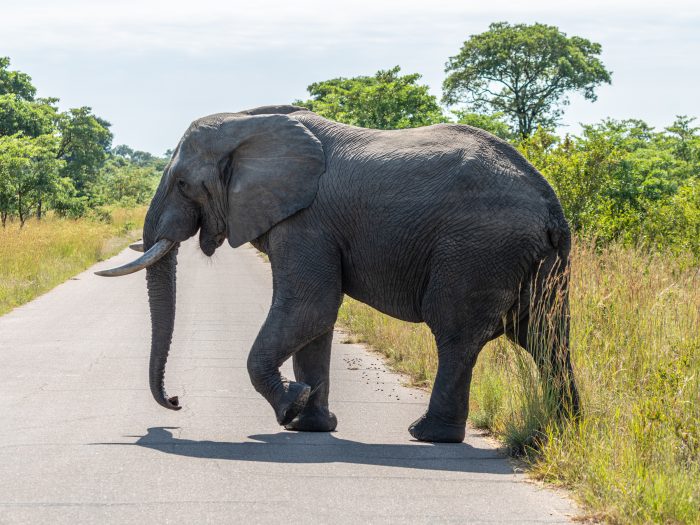
An elephant on a road in Kruger National Park, a dedicated wildlife reserve, South Africa, 2024. Photo: Taryn Elliott, Pexels
In early 2026, the human population surpassed 8.3 billion. Staggering population growth over the 20th and 21st centuries prompted conservationists and environmentalists to urgently call for sustainable sharing of land and resources between humans and wildlife. Across southern Africa, that coexistence remains fragile as human-wildlife conflict is a growing concern.
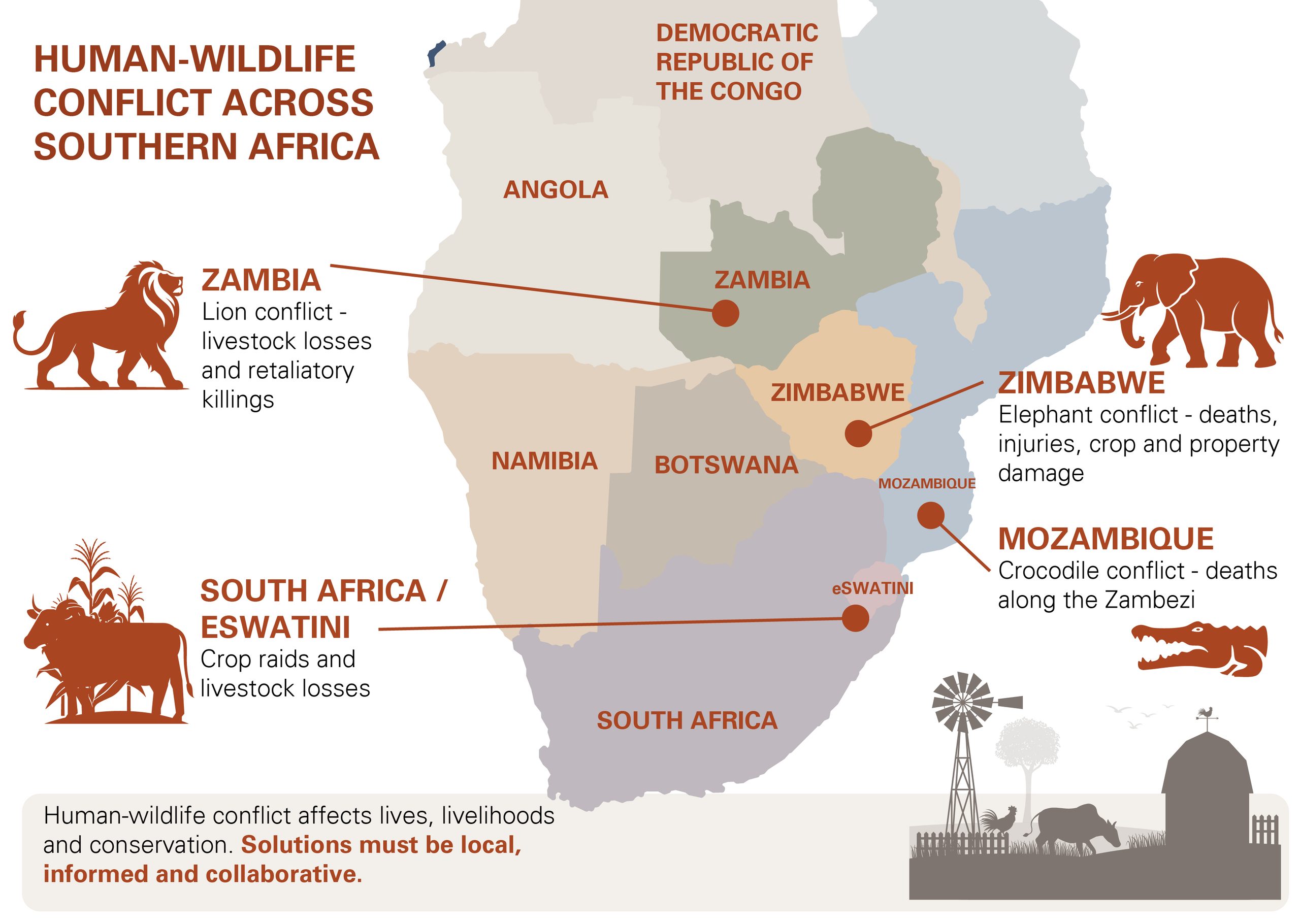
For example, a recent article in the Daily Maverick by Vuyisile Hlatshwayo reported that wildlife moving through a private reserve fence across the South Africa–ESwatini border has led to persistent crop raids and livestock losses, deepening food insecurity, poverty and the risk of disease in neighbouring Eswatini communities.
Interactions between humans and wildlife negatively impact wildlife, as retaliatory killings and habitat encroachment can destabilise ecosystems, reduce biodiversity, and contribute to the decline of vulnerable species. Yet this news article vividly illustrates how human-wildlife conflict can negatively impact humans too, by affecting crops, livestock, safety, and rural livelihoods.
This is especially significant in the Southern African Development Community (SADC), a region already facing entrenched poverty and food insecurity. According to the World Bank, extreme poverty in sub-Saharan Africa reached 46% in 2024 and remains particularly acute in eastern and southern Africa.
The study
“Human-wildlife conflict is not only a conservation concern but also a significant development and humanitarian issue, particularly affecting vulnerable communities living below the poverty line,” HSRC researchers and a partner recently argued in Chapter 3: Human-Wildlife Conflict in Mozambique, South Africa, and Zimbabwe: More Than Just a Conservation Concern of The Palgrave Handbook of Human-Animal Interactions in the Global Context of Climate Change, Disasters, and Other Crises.
HSRC researchers Wilfred Lunga, Caiphus Baloyi, Tshegofatso Ramaphakela and Dimpho Makitla, together with co-author Dr Charles Musarurwa from Midlands State University, Zimbabwe, examined human-wildlife conflict in the southern Africa region to identify practical, context-sensitive solutions for reducing conflict and supporting coexistence between people and wildlife.
Examples of human-wildlife conflict
A news article reported that in Hwange National Park in Zimbabwe, human-elephant conflict led to 71 deaths and 50 injuries in 2021 and 60 deaths and 40 injuries in 2020. Alongside threats to human life, elephants frequently raid crops and damage property, creating economic losses.
In the Luangwa Valley of Zambia, human-lion conflict poses serious challenges to local communities. There, attacks on livestock and occasional threats to human life have contributed to retaliatory killings of lions.
In Mozambique, crocodile attacks on humans are a major problem along the Zambezi River, especially during the rainy season when water levels rise. According to Mozambique’s Ministry of Land and Environment, at least 200 people have died because of human-wildlife conflict since 2019.
Conflict drivers
The chapter shows that human-wildlife conflict in the southern Africa region was shaped by a combination of social, environmental and governance pressures rather than by wildlife behaviour alone.
Population growth and settlement expansion into wildlife areas have brought people, farms and infrastructure into spaces once used more exclusively by wild animals, increasing the chances of dangerous encounters and damage to property and crops.
Agricultural expansion and habitat loss are shrinking and fragmenting ecosystems, making it harder for wildlife to move and feed without crossing into cultivated or settled areas.
Competition over land and natural resources further intensifies this pressure, especially where communities depend directly on farming, grazing, water and other ecosystem resources for survival.
Climate change is worsening the situation by increasing droughts, floods and other environmental shocks that can alter wildlife movement, reduce available habitat and push animals into closer contact with human settlements.
Limited or fragmented policy responses ensure that weak coordination, poor integration across sectors and gaps between conservation and disaster risk strategies can leave communities more exposed and conflict harder to manage.
Communities need to benefit from wildlife instead of bearing only the cost
“To mitigate human-wildlife conflict and improve tolerance for wildlife among local communities, it is essential to establish a common understanding between the local population and authorities regarding the risks versus benefits involved,” researchers wrote.
The chapter argues that coexistence is difficult because the costs of living with wildlife are often endured most heavily by rural communities. Yet the communities that live closest to wildlife often see few, if any, of the benefits associated with its conservation. Crop destruction, livestock losses, property damage and threats to human safety can make wildlife feel less like a shared natural asset and more like a daily risk.
Researchers in this study argued that coexistence is therefore not only about keeping wildlife alive, but about creating conditions in which people can live with wildlife at acceptable levels of risk in comparison to the benefits they may gain. This requires strong institutions, local trust, practical support and benefits that communities can genuinely feel.
Zimbabwe’s CAMPFIRE programme
A good example of an attempt to make coexistence work in practice is Zimbabwe’s CAMPFIRE programme, a major community-based natural resource management initiative designed to give rural communities a direct stake in wildlife conservation. CAMPFIRE has helped create incentives for communities to see wildlife as an asset rather than only a threat, by linking wildlife to benefits such as tourism income, safari-hunting revenue and other locally generated funds.
The programme has simultaneously contributed to conservation while creating opportunities for local benefit-sharing, showing the potential of community-centred approaches to reduce conflict and support coexistence.
Despite its successes, the programme has had problems with unequal revenue distribution, wavering donor support and increasing pressure from elephants, all of which limited its ability to deliver fair and lasting benefits to communities living closest to wildlife.
What should be done?
The researchers argue that reducing human-wildlife conflict requires inclusive wildlife policies that take the livelihoods, safety and everyday realities of communities living closest to wildlife seriously. Conservation responses need to address not only biodiversity protection, but also how the costs and benefits of living with wildlife are shared.
As climate change shrinks wildlife habitats and the need arises to recover predator populations, pressure on shared spaces intensifies. This presents an opportunity to rethink land-use systems that bring people and wildlife into closer contact. Without changes to how these spaces are managed, retaliatory killings could further diminish important wildlife species.
There is also a need to strengthen community institutions and local decision-making. When communities are meaningfully involved in managing wildlife and responding to conflict, trust can grow and local responses can become more effective. Additionally, coexistence is more likely to succeed when people experience wildlife not only as a risk, but also as a source of opportunity. Distrust in institutions and weak coordination are serious problems, but they could also push the development of shared management systems, where different groups work together to respond to conflict and build resilience.
Improving compensation for losses and damages is another important step. When crops are destroyed, livestock are killed or people are harmed, timely and fair support can reduce hardship and improve tolerance for wildlife. Current compensation schemes typically fail because of bureaucratic lag or underfunding. These failures could be reframed as an opportunity to deploy insurance models that pay out automatically upon verified loss events (such as when rainfall drops below a certain level) and mobile payment platforms, cutting response time from months to days.
Conservationists and decision makers need to protect ecological corridors and limit settlement in high-conflict areas. Better land-use planning could help reduce direct contact between people and wildlife. The ongoing expansion of agriculture into migration corridors is not merely a land-use problem; it is an ecological debt trap. Strategic corridor restoration and buffer zone incentives may offer a triple win, reducing mortality on both sides, enhancing genetic flow for endangered species, and accessing funding through nature-based projects, such as forests or wetlands, to capture and store carbon.
Researchers also recommend combining local knowledge with technologies such as monitoring and early-warning systems. Together, these can help communities anticipate risks and respond before conflict escalates. For example, combining real-time sound and movement sensors with indigenous tracking knowledge can help communities predict wildlife movement, instead of reacting only after conflict happens. Evidence suggests such early-warning approaches can substantially reduce conflict. For example, an Indian programme reported an overall 60–70% decline after introducing a technology-supported warning system alongside other conservation measures.
Impact
By showing how conflict disrupts food security, livelihoods and community wellbeing, and highlighting the importance of community-centred institutions and policy reform, this research could help shift the conversation from protecting wildlife alone to building conditions for coexistence that work for both people and biodiversity.
“Our analysis highlights the importance of community involvement, alternative livelihoods and sustainable resource management in reducing human-wildlife conflict and fostering co-existence,” researchers wrote.
Research contacts and acknowledgements
This Review article was written by Jessie-Lee Smith with inputs from Dr Wilfred Lunga. It was based on the chapter Human-Wildlife Conflict in Mozambique, South Africa, and Zimbabwe: More Than Just a Conservation Concern in the book The Palgrave Handbook of Human-Animal Interactions in the Global Context of Climate Change, Disasters, and Other Crises.
For more information about this work, please contact Lunga at wlunga@hsrc.ac.za.
The research team included Dr Wilfred Lunga, Caiphus Baloyi, Tshegofatso Ramaphakela and Dimpho Makitla from the HSRC’s Research, Development, Science and Innovation Division and Dr Charles Musarurwa from Midlands State University, Zimbabwe.