


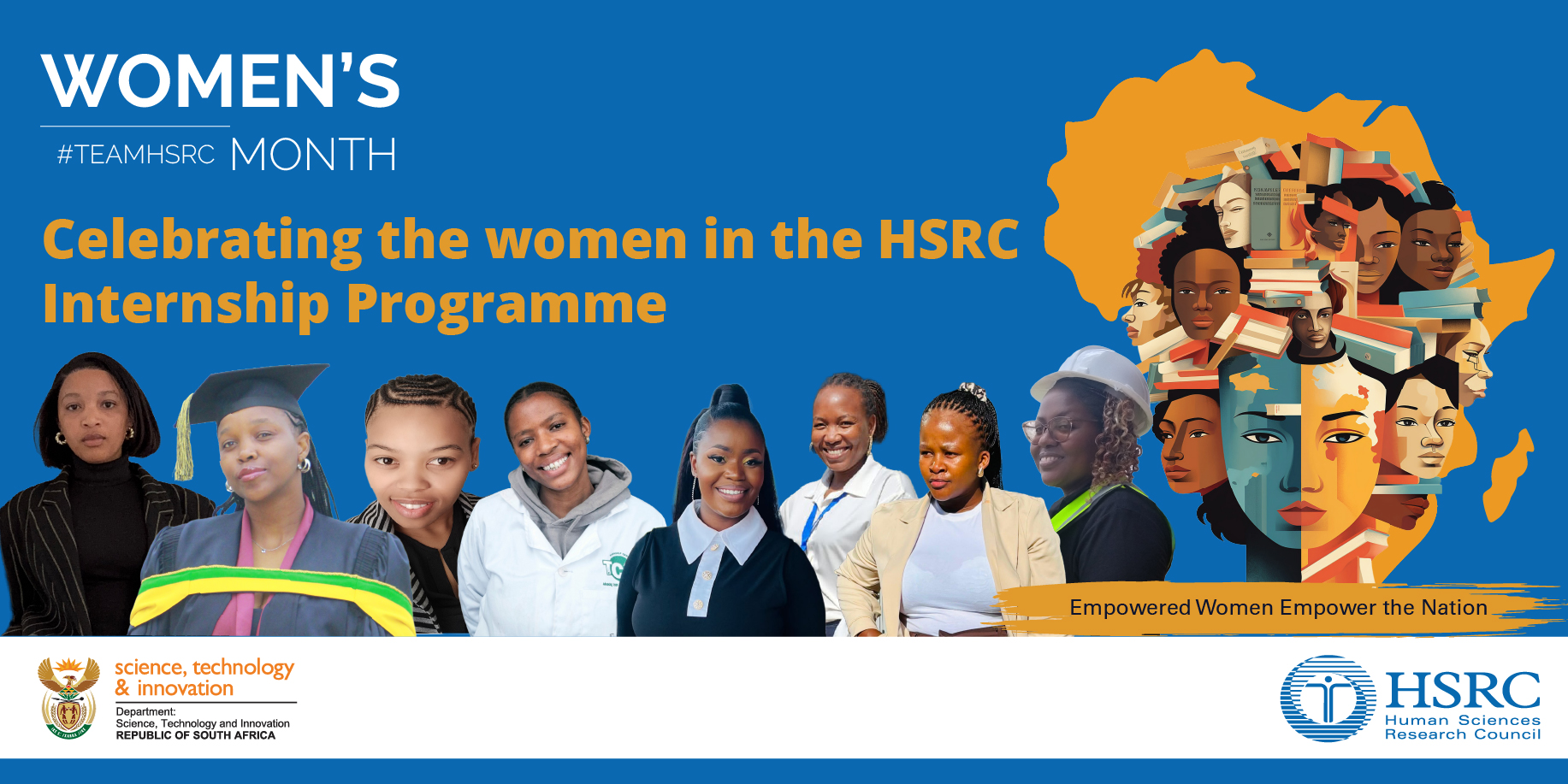
Women’s Month is a time to celebrate the achievements, strength and resilience of women. But it is also an opportunity to reflect on the progress that has been made, the challenges that remain, and the possibilities that open up when women are given the opportunity to learn, grow and make their mark.
For a group of young women participating in the Human Sciences Research Council (HSRC) Internship Programme, this year’s Women’s Month is particularly personal. Their experiences reflect a generation of women entering fields ranging from research and academia to environmental science, agriculture, geospatial technology, public administration and business – building careers while developing the confidence to imagine themselves as future leaders in their fields.
For Muneza Munyantore, a research intern hosted by the University of Fort Hare, Women’s Month is about “impact in motion”.
“It’s about women who learn, adapt and create space for others to grow,” she says. As a young woman in research, the month encourages her to believe in her potential and use her knowledge and skills to contribute to a better future. That sense of possibility runs through many of the women’s reflections. While they come from different backgrounds and are pursuing very different career paths, their stories share a common thread: opportunity has helped them recognise their own potential.
Finding confidence through opportunity
For many of the interns, the HSRC Internship Programme has been about much more than gaining experience for a CV. It has provided an opportunity to translate academic knowledge into practical skills, work alongside experienced professionals and discover new possibilities for their careers.
Muneza, who is completing a Master’s degree in Biostatistics, says her internship has allowed her to work with real-world data while strengthening her research, statistical analysis, communication and teamwork skills. Her experience has also deepened her understanding of how research can be used to address social challenges. “As a woman, I am proud because I get to turn numbers into narratives that can help improve lives,” she says.
For Sadiki Thalukanyo Cleopatra Mufunwa, an HSRC intern hosted at the University of Venda, the experience has brought a profound change in confidence. When she started her internship, she was often nervous about speaking in front of people. Today, she is able to confidently present her work, share ideas and engage with academics and researchers. The experience has reinforced her ambition to become a lecturer in higher education.
“Every opportunity to conduct research, publish, mentor students, and work with experienced academics is preparing me for the career I hope to build,” she says. Her goal is to inspire students, contribute meaningful research and make a lasting impact through education.
This transformation – from learning to confidence, and from confidence to aspiration – is echoed across the women’s experiences.
An intern working in the People & Culture unit at the HSRC describes how the stability and professional exposure provided by the programme have helped her gain confidence in her abilities. She says she now feels less hesitant when putting herself forward for future employment opportunities.
For Alizwe Mabaso, an Administrative Intern in Cape Town, the programme has strengthened her administrative, communication and organisational skills while giving her practical workplace experience and a deeper appreciation of teamwork and continuous learning.
Breaking barriers and making space
The diversity of the women’s career paths is itself a powerful reflection of changing possibilities for young women. They are building expertise in fields that require technical knowledge, analytical skills and innovation. Nosibusiso Nomchutsha, a Geospatial Computing and Analytics Intern, works with Geographic Information Systems (GIS), remote sensing, spatial analysis, and data management. Her experience has shown her how geospatial technologies can contribute to addressing societal and environmental challenges, and has strengthened her ambition to become a specialist in the field.
Tshimangadzo Yollenda Nndwakhulu is pursuing a career in environmental science. Her internship has exposed her to environmental impact assessments, biodiversity and ecological assessments, environmental compliance, stakeholder engagement and sustainable development. For her, being a young woman in the environmental sector is also about demonstrating that women belong in spaces where they have traditionally been underrepresented. “I am proud that my journey demonstrates that young women belong in science, environmental management and leadership,” she says.
Sina Mashishi is building towards a career in academia and research. While pursuing a PhD in Agriculture at the University of Venda, her work focuses on sustainable potato production, soil health and climate-smart agricultural practices. Her internship has allowed her to combine research with teaching, academic administration and student support – experiences that are preparing her for the three interconnected dimensions of an academic career: research, teaching and service.
Others are finding their paths in public administration, entrepreneurship, business development, disability advocacy and organisational development.
Together, their stories demonstrate that there is no single way to define a career in which women can lead, contribute and create impact.
Carrying others forward
For these women, success is also about what they can make possible for others.
Women’s Month, says Idlet Kgatla, is a reminder to embrace opportunities for growth, support other women and strive to make a positive impact in the community and workplace. That commitment to uplifting others appears repeatedly throughout conversations with the women of the HSRC Internship Programme. They speak of inspiring other young women, creating space for others to grow, mentoring students, contributing to communities, and using their knowledge to make a difference.
It is a reminder that empowerment is rarely an individual journey. The women who inspire us can become the women who, in turn, create opportunities and encouragement for those coming after them.
For one intern, the influence of women began at home. Raised by a strong single mother, she describes how watching her mother overcome challenges with courage and determination taught her that no dream is too big when you are willing to work hard and believe in yourself. Another speaks proudly of coming from a matriarchal family where women “show up for each other”, teaching and learning from one another across generations.
These reflections add another dimension to Women’s Month: celebrating not only what women achieve, but also the networks of support, example and encouragement that help them get there.
More than a celebration
While celebration is central to Women’s Month, some of the interns’ reflections also acknowledge the inequalities that continue to shape women’s lives.
One participant describes Women’s Month as a “layered experience”. Alongside the appreciation women receive, she says it is a chance to reflect honestly on the realities of womanhood in South Africa, including unequal professional opportunities, economic barriers and the pressure of balancing competing expectations. Another highlights the need to keep conversations around gender-based violence at the centre of Women’s Month.
These perspectives are important. They remind us that celebrating progress should not mean losing sight of the work that remains. For the young women in the HSRC Internship Programme, however, their stories also offer a glimpse of what progress can look like: women gaining access to professional spaces, developing new skills, finding their voices, and preparing themselves to contribute to the future of South Africa.
Looking ahead
Perhaps the most powerful message emerging from these reflections is that the women are not simply celebrating where they are now. They are looking ahead to what they can become. They are aspiring to become researchers, academics, scientists, environmental professionals, business leaders and public-sector professionals. They are learning to turn data into knowledge, knowledge into action, and opportunity into possibility.
Their journeys are still unfolding.
But as Women’s Month provides a moment to celebrate the achievements of women who came before them, these young women are already beginning to shape the next chapter – one defined by knowledge, resilience, confidence and a determination to create space for others. As one intern puts it: “I hope my journey encourages other young women to believe in themselves, embrace every opportunity, and never stop striving for excellence.”
That may be one of the most fitting ways to understand Women’s Month: not simply as a celebration of what women have achieved, but as an invitation to imagine – and build – what comes next.