


Initiation rites have long been practised across many African societies, where they constitute an important cultural institution and a significant rite of passage into adulthood. A new HSRC study foregrounds the lived experiences of women who have undergone initiation and the meanings they attach to the practice, contributing to a more nuanced understanding of a cultural institution that has remained largely underrepresented in academic scholarship.
Initiation rites are a deeply rooted cultural institution that shapes identity, social belonging and the transition to adulthood among men and women across generations. However, when female initiation is discussed, it is often framed through biomedical, human-rights, and gender-based perspectives that foreground female genital mutilation and other bodily harm, as well as the perpetuation of patriarchal gender norms. While these perspectives are important for identifying practices that violate and threaten the health, dignity and rights of women and girls, they risk homogenising culturally diverse forms of female initiation.
A recent article by HSRC researchers in collaboration with the University of Limpopo, the University of Mpumalanga, the University of South Africa and Botswana’s Human Resource Development Council intended to address these gaps in research by examining the psychological and social significance of koma ya basadi among Bakopa of Ga-Sekhukhune in Limpopo Province. As a non-surgical rite of passage, koma ya basadi centres on intergenerational knowledge transmission and culturally embedded understandings of becoming a woman.
The study was conducted through key informant interviews with 16 women from the Bakopa community. These interviews were complemented by one focus group with six participants and a one-on-one discussion with two participants, for a total of 24 women. All participants had lived experience of the practice.
Koma ya basadi
Koma ya basadi (female initiation process or rites) is conducted in three stages. Girls generally go for initiation from the age of 12 years. In Go rupa,the first phase of the initiation process, girls enter seclusion and receive cultural instruction while taking part in activities intended to build discipline, obedience and resilience. This is followed by Botsho, a liminal or ‘mourning’ phase symbolising the end of childhood, during which initiates follow strict moral codes and are taught about gender roles, community responsibilities and adulthood. The final stage, Boramaswaile, marks their reintegration into the community through ceremonial dress, public celebration and recognition of their new status as women.
Psychological and social significance
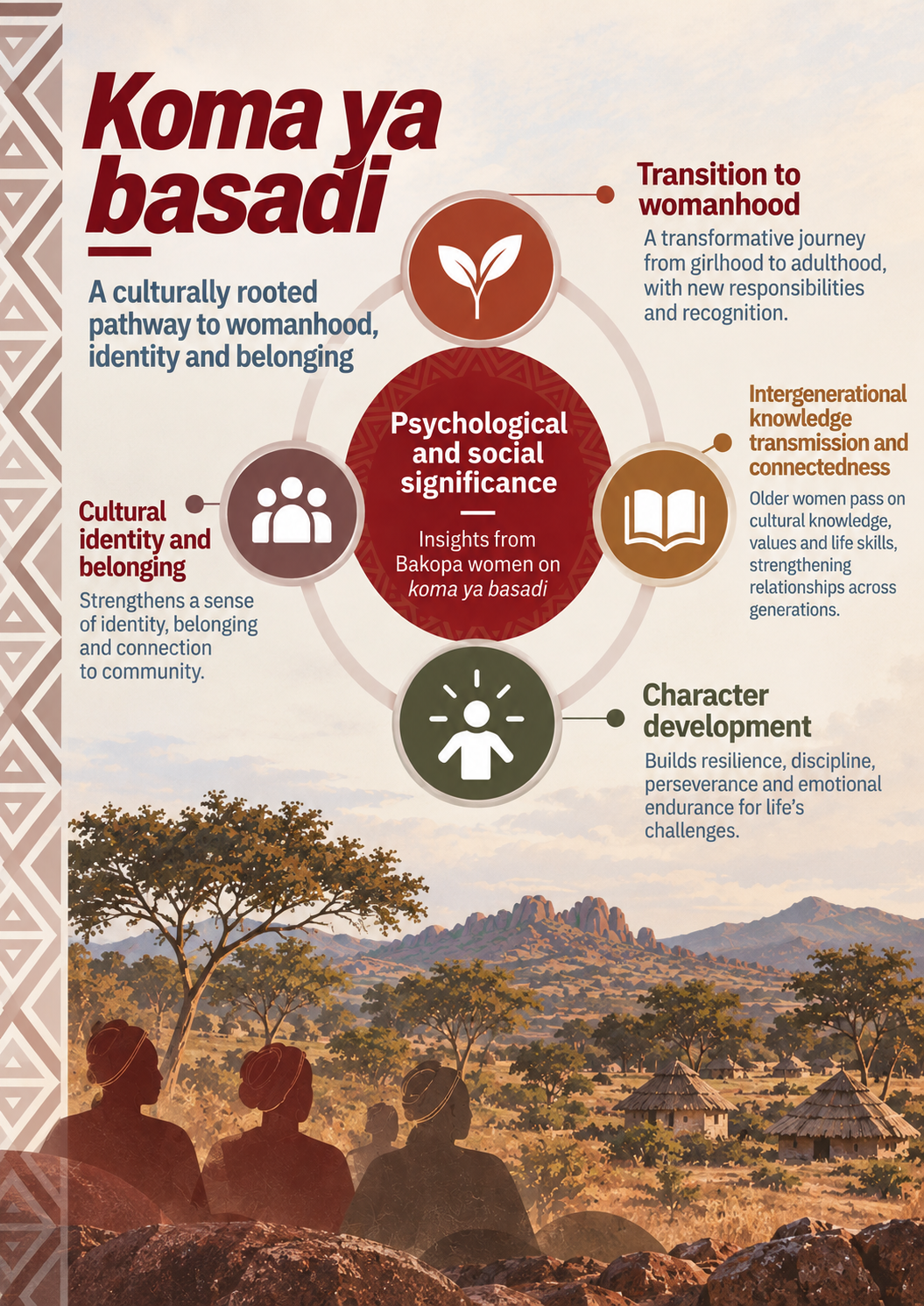
Understanding koma ya basadi requires attention not only to broader debates about gender and tradition but also to the meaning women ascribe to their experiences of initiation. Four themes emerged from the study: transition to womanhood, cultural identity and belonging, intergenerational knowledge transmission and connectedness, and character development.
Transition from girlhood to womanhood and preparedness to adulthood
The findings indicated that female initiation rites were understood by participants as a significant social status transition from girlhood to womanhood. Rather than being viewed solely as a ceremonial event, koma ya basadi was described as a transformative process through which initiates acquired recognition as adult women and became eligible to assume the responsibilities associated with womanhood.
Additionally, participants understood the teachings and experiences acquired during koma ya basadi as preparing young women for the social, relational, moral and practical responsibilities expected of adult women. The initiation process represented more than a symbolic transition – it provided a framework through which girls were socialised into culturally recognised expectations of womanhood. The findings suggest that initiation functions as an important mechanism through which individual maturity is socially acknowledged as adult status bestowed.
Cultural identity and belonging
A second finding was the strengthening of cultural identity and belonging. Participants associated initiation with learning and embodying the values, traditions, expectations and practices of their community. The process provided initiates with a clearer understanding of who they were and where they belonged within the Bakopa social and cultural environment. One participant said: ‘It must always be there; it would not be possible that others go through it and others do not … so that they belong.’
Belonging was particularly evident in participants’ accounts of peer and community relationships, with some indicating that undergoing initiation enabled them to identify with other initiated women and participate more fully in community life. Conversely, those who had not undergone initiation could experience exclusion or a perceived loss of social belonging. For example, one participant noted: ‘I used to be envious of seeing people who went through the initiation process, especially my age group, coming back with their initiation names. I still used my childhood name and could not even play with them.’
Intergenerational knowledge transmission and connectedness
The findings demonstrated that initiation also served as a mechanism for intergenerational knowledge transmission and social connectedness. Older women played an important role in transmitting cultural knowledge, moral teachings, behavioural expectations, and an understanding of adult responsibilities to younger women.
In this sense, the initiation setting created structured relationships between generations, allowing cultural knowledge to be preserved and reproduced while at the same time strengthening relationships among women. The findings positioned initiation as both educational and a culturally embedded form of psychosocial support that connected individuals to their families, peers, elders and wider community.
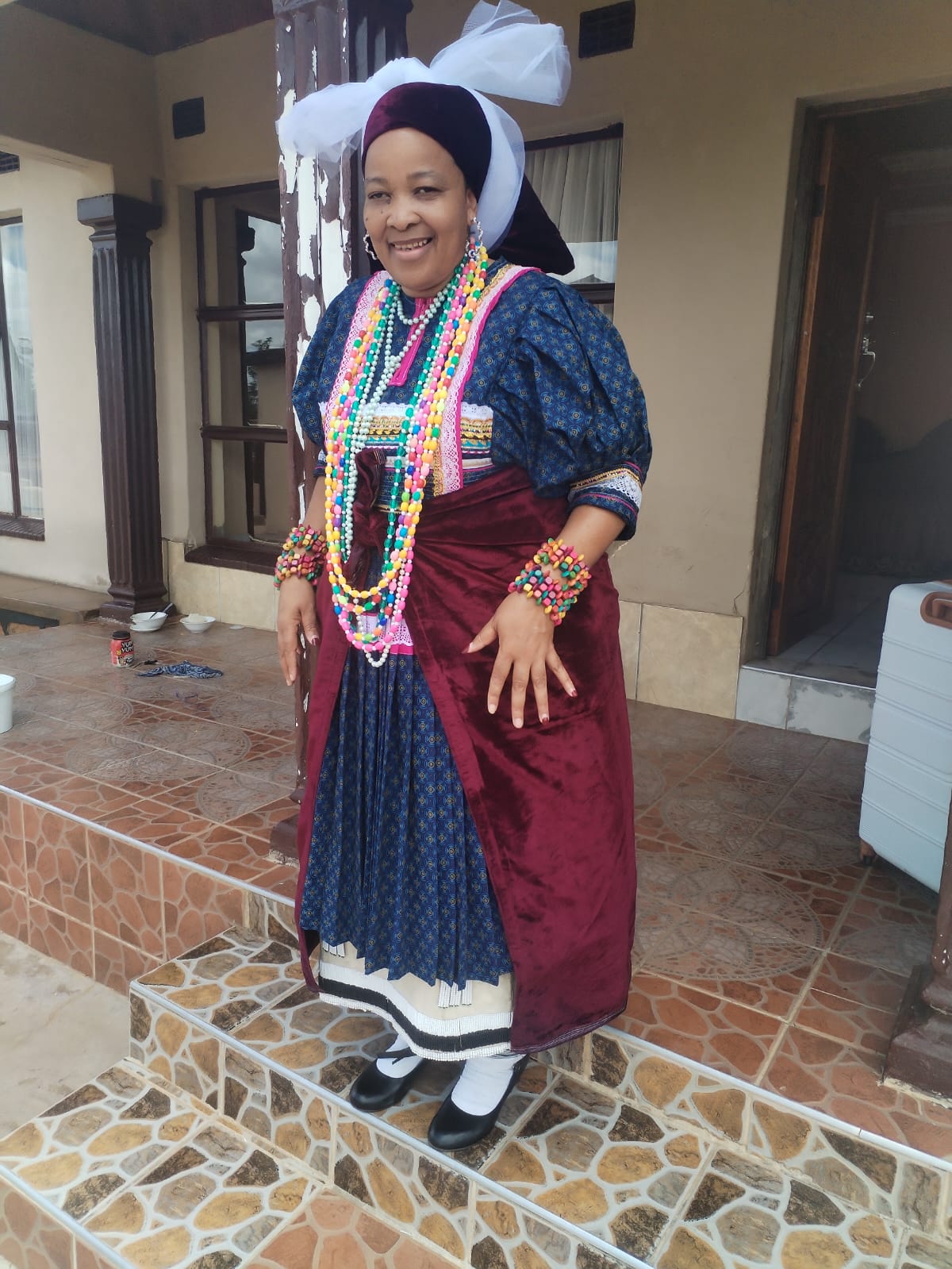
Dr Mmakotsedi Magampa, an HSRC research specialist, wears attire representing a married, divorced or widowed woman who has undergone the initiation rites. Photo: HSRC
Character development
Another theme concerned resilience and character development. Participants described the initiation experience as contributing to perseverance, tolerance, discipline and emotional endurance. One participant said: ‘Koma imparts the right maturity … and gives a person a new perspective. When initiated, you become considerate.’
The challenges and teachings associated with the initiation process were understood as opportunities to develop qualities necessary for coping with difficulties and fulfilling adult responsibilities. Another participant said, ‘It inculcates perseverance in a person’, and another noted, ‘In marriage, you will find the in-laws making your life difficult, but because you have learnt to handle difficulties during koma, the treatment does not matter much as you console yourself that this too will pass the same way koma did.’
Therefore, resilience was presented as a culturally cultivated quality developed through participating in a collective rite of passage. The study specifically identifies perseverance and tolerance as qualities that initiation seeks to instil in participants.
Impact
These findings provide an important perspective on how culture can influence psychological and social development. By examining koma ya basadi through the lived experiences of initiated Bakopa women, the study offered a contextually grounded account of the psychological significance attributed to female initiation. Participants’ accounts positioned initiation as more than a social-status transition; they associated it with cultural identity, belonging, resilience, intergenerational knowledge, social connectedness and preparedness for adulthood.
These findings complicate generalised understandings of female initiation and demonstrate the value of attending to culturally specific meanings and experiences. Importantly, they identify culturally grounded dimensions of identity, belonging and social support that may be relevant to broader understandings of psychological well-being.
Overall, the study’s findings support a culturally responsive and rights-based approach to understanding initiation rites in contemporary South Africa. Such an approach recognises cultural knowledge and community relationships as potentially meaningful dimensions of well-being while maintaining attention to safety, voluntary participation, dignity and agency. More research is needed to investigate how female initiation practices negotiate gender variance, including the inclusion and experiences of intersex, transgender, and gender-diverse people, and what these negotiations reveal about participation, belonging, identity and the cultural boundaries of womanhood.
Research contacts and acknowledgements
This Review article is based on a journal article titled ‘The psychological significance of female traditional initiation rites among the Bakopa community of South Africa: a qualitative approach to the understanding of koma ya basadi’.
The Review article was written by Dr Mmakotsedi Magampa (research specialist) in the HSRC’s Research Impact Division and Dr Lehlogonolo Makola (senior research specialist) in the HSRC’s Public Health, Societies and Belonging Division, with inputs from HSRC science writer Jessie-Lee Smith. For more information about this work, please contact Magampa at mmagampa@hsrc.ac.za.
The study team consisted of the HSRC’s Dr Mmakotsedi Magampa, Dr Lehlogonolo Makola and Dr Abongile Pindo; Prof. Thelmah Maluleke and Prof. Tholene Sodi (University of Limpopo); Dr Rudzani Marry Mhlari (University of Mpumalanga); Dr Anastasia Julia Ngobe (Unisa); and Prof. Alinah K Segobye (Botswana’s Human Resource Development Council).