


In short
- HSRC survey findings show that the legacy of the 1976 Soweto Uprising and the 2015–16 Fallist movements continues to shape public attitudes toward higher education.
- #FeesMustFall remains the most widely recognised social movement, with awareness highest among young adults aged 16–34.
- Free university education is the best-known goal of the Fallist movements, while transformation, African languages and increased representation are also widely recognised.
- Public support for free higher education is overwhelming, with 89% of South Africans supporting some form of free access to tertiary education.
The 16 June 1976 Soweto Uprising formed a critical part of the opposition to apartheid injustices. Learners resisted the imposition of Afrikaans as a language of instruction in schools and demanded an end to Bantu Education. Four decades later, in 2015 and 2016, a new generation of university students, through the “Fallist” movements, challenged enduring exclusion in higher education, driven not only by race but by financial inequality, and advocated for free higher education for all. Recent research from the HSRC-led South African Social Attitudes Survey (SASAS) included a set of questions on the enduring legacy of social movements in South Africa. The module asked whether the struggle for equitable and inclusive education in South Africa has been achieved, 50 years after 1976.
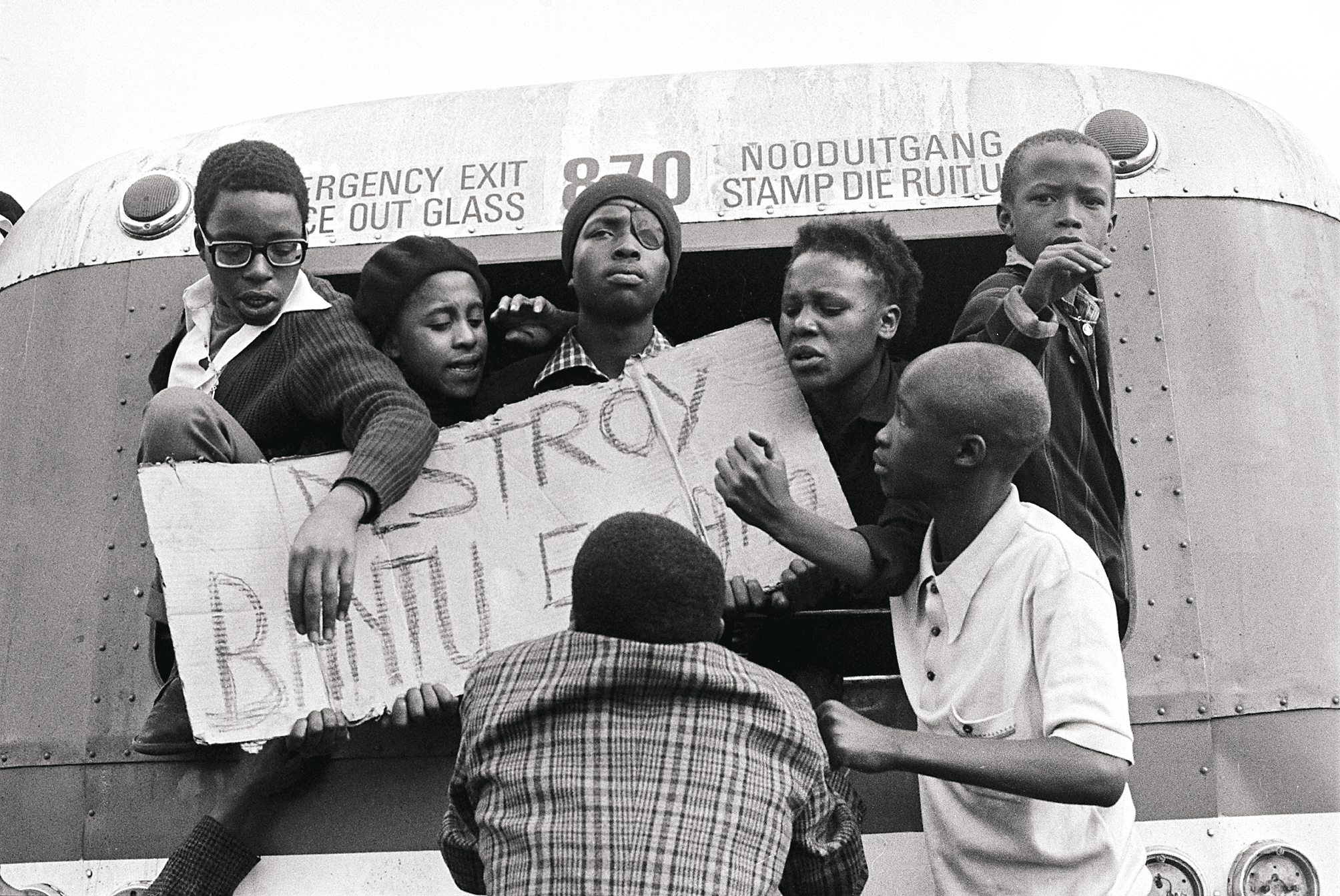
After June 1976, young people increasingly played an important role in the liberation struggle. These students are hanging out of a bus holding a poster protesting Bantu Education. Photo: Alf Kumalo, african.pictures
The youth of 16 June 1976 resisted the policies of the Bantu Education Act of 1953, which institutionalised inferior education for black students by enforcing Afrikaans as the language of instruction and limiting black students’ access to subjects and institutions.
Alongside broader resistance from trade unions and civil society, student organisations such as the Black Consciousness Movement and the South African Students Organisation played a pivotal role in raising political consciousness and mobilising school learners. What was intended as a peaceful march became a nationwide uprising against the apartheid state after state security forces responded with lethal violence.
In 2016, 40 years later, the #RhodesMustFall movement, which protested colonial legacies and institutional racism in higher education, and the #FeesMustFall movement, which demanded free higher education, continued this legacy of resistance. Together, these movements, now collectively referred to as the “Fallist movements”, challenged exclusionary and colonial structures within universities.
To study the enduring legacy of these and other contemporary social movements, the 2025 round of the South African Social Attitudes Survey (SASAS) included a set of questions on public knowledge and perceptions of social movements in South Africa. The findings, published in the New Agenda article #FeesMustFall and the 2015/16 student movement in popular memory, showed that the Fallist movements remained widely remembered and that their demands continued to resonate with the majority of South Africans, who supported free and accessible higher education.
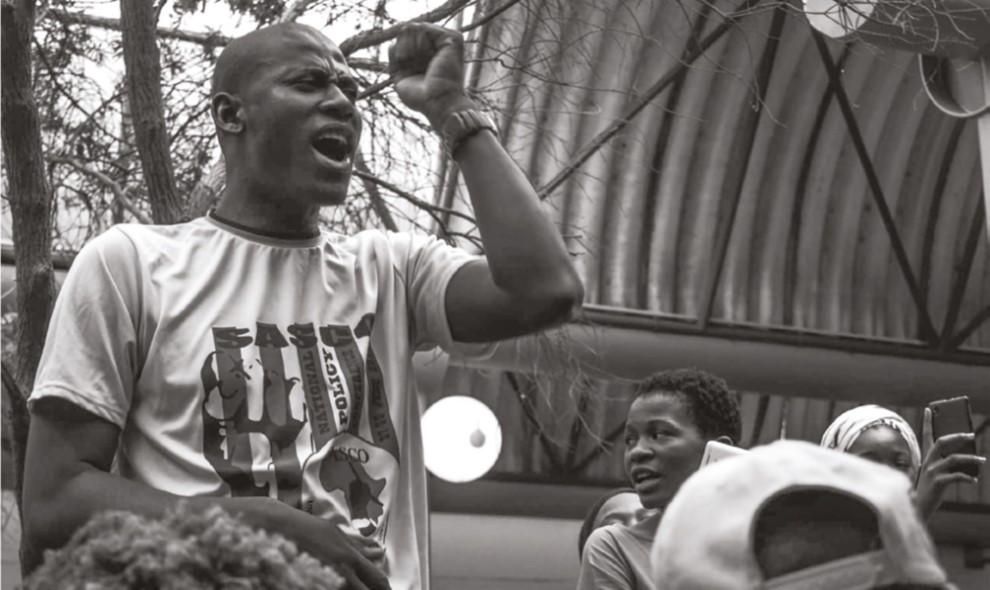
‘Out of power, but not out of responsibility’ by Siphephelo (Shange) Mthembu from Durban University of Technology. The photograph was part of Aftermath: Violence and Well-being in the Context of the Student Movement, a book and photographic exhibition revealing the mental health impact of #FeesMustFall protests.
Knowledge of social movements in general
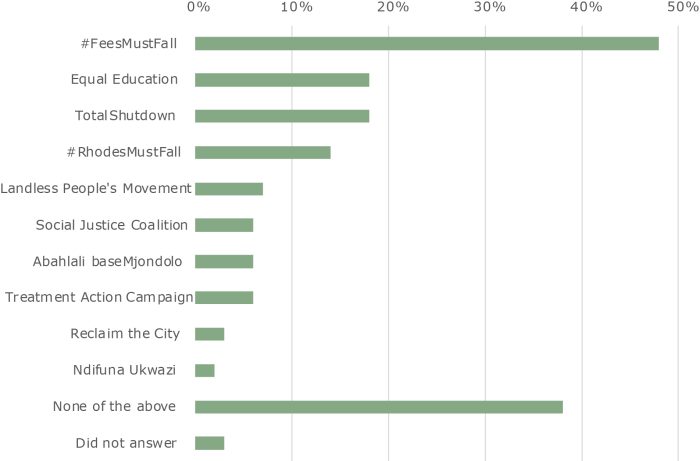
South Africa is home to a range of social movements advocating for marginalised and disadvantaged groups. Figure 1 illustrates public awareness of selected movements, based on SASAS 2025 data.
Presented with a list of contemporary social movements, approximately 48% of South Africans reported awareness of #FeesMustFall (#FMF), while 38% said they were not aware of any social movement.
Awareness of Equal Education and Total Shutdown – a 2018 movement protesting gender-based violence – stood at 18% each, while 14% of respondents were familiar with #RhodesMustFall (#RMF). Awareness of other movements, including the Landless People’s Movement, the Social Justice Coalition and Abahlali baseMjondolo (a social movement protesting inhuman living conditions) was below 10%.
Although #FMF (in 2016) followed closely after #RMF (which began in 2015 at the University of Cape Town), #FMF was more widely recognised, largely because of its nationwide reach and its focus on equitable access to higher education.
Figure 1. Familiarity with different social movements in South Africa
Source: HSRC SASAS 2025 Social Movements module
Awareness of Fallist movement goals
While general awareness of social movements is important, the survey also sought to understand who remains concerned about educational equality and access as South Africa marks 50 years since the Soweto Uprising.
The SASAS analysis therefore focused specifically on knowledge of the Fallist movements – #FMF and #RMF. A key finding was that knowledge of these movements was highest among individuals aged 16–34 years (52% for #FMF and 15% for #RMF). Older age groups demonstrated lower levels of familiarity. Men were more likely than women to report knowledge of the movements. Awareness was high among black African adults (50%) and white South Africans (51%), while Coloured adults reported slightly lower levels of familiarity (48%).
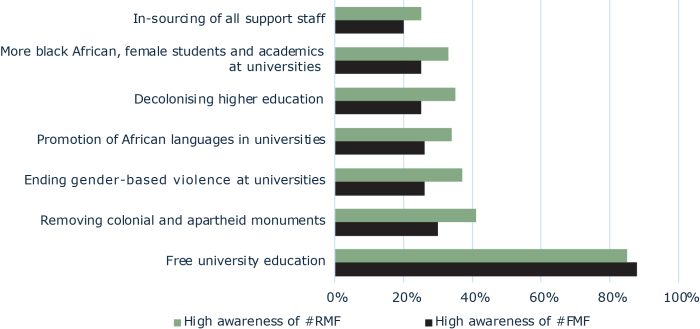
To assess the depth of public understanding, respondents were also asked about the perceived goals of the Fallist movements. Figure 2 summarises the findings.
Figure 2. Percentage of respondents who reported awareness of Fallist movements’ goals
Source: HSRC SASAS 2025 Social Movements module
The findings show that “free university education” was by far the most widely recognised goal, identified by 85–89% of adults, regardless of their general level of awareness of the movements.
Other recognised goals included demanding that universities insource support staff such as gardeners, cleaners and security guards rather than outsourcing these services; removing colonial and apartheid symbols; ending gender-based violence; incorporating African languages into curricula; broader education transformation (decolonising education); and increasing representation of black students and lecturers. These goals were mentioned by 21–27% of respondents.
Perceived outcomes of the Fallist movements
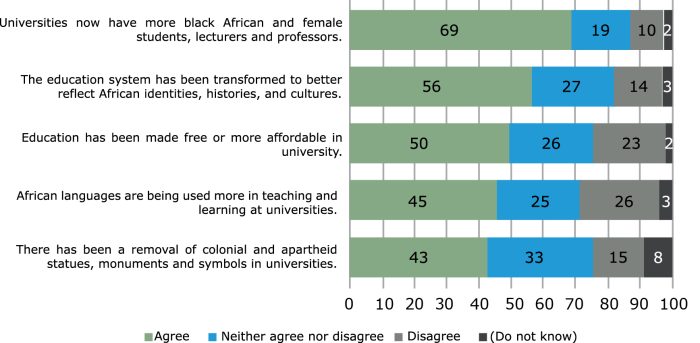
The SASAS module also asked respondents familiar with the Fallist movements whether they believed the movements’ goals had been achieved. Figure 3 presents these findings.
Figure 3. Percentage of respondents who agreed that various goals of the Fallist movements had been achieved
Source: HSRC SASAS 2025 Social Movements module
Notably, 69% of respondents believed that universities now have increased representation of black African and female students, lecturers, and professors.
Half of respondents (50%) believed that higher education had become either free or more affordable, while 56% believed that the education system had been transformed to better reflect African identities, histories, and cultures.
Fewer respondents believed that the goal of increasing the use of African languages in universities had been achieved (45%), or that of removing colonial and apartheid statues (43%).
These findings indicate that while representation may be improving, meaningful transformation remains an ongoing process.
Support for free higher education
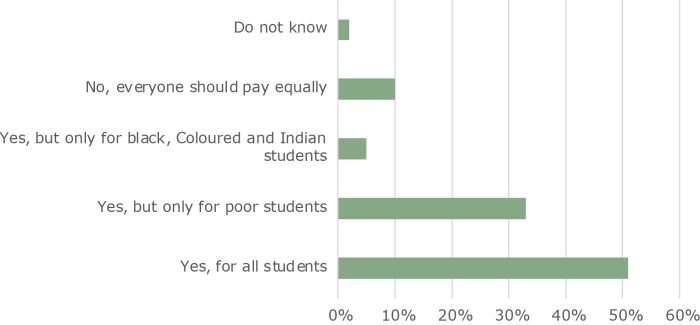
The SASAS survey also examined respondents’ attitudes to free higher education. The findings reveal strong public support for the principle of free access to education, with 89% of South African adults expressing support.
Among these respondents, 51% believed that education should be free for all students, 33% supported free education only for students from low-income backgrounds, and 5% believed it should be limited to previously disadvantaged groups. Only 10% of respondents believed that all students should pay equally for higher education (Figure 4).
Figure 4. Support for free access to education by South African adults
Source: HSRC SASAS 2025 Social Movements module
A decade after the Fallist movements demanded free higher education and institutional transformation, the SASAS findings show that public awareness remains high. The demands of these movements continue to shape public thinking about access to, and representation within, higher education in South Africa.
As Nomkhosi Mbatha, Thierry Luescher and Benjamin Roberts write in the New Agenda article: “The legacy of the Fallist movements is most strikingly evident in public support for the principle of free higher education. […] This aligns with #FMF’s central demand and illustrates how what began as a student protest has crystallised into a normative expectation among the broader population.”
The authors add that the survey raises broader questions about how South Africa can bridge generational divides, address and redress persistent inequalities, and advance the project of building inclusive and decolonised African universities.
Research contacts and acknowledgements
This Review article was written by Nomkhosi Mbatha (PhD researcher trainee) and Dr Kukhanyile Mali (research specialist) in the HSRC’s Equitable Education and Economies Division, as well as Dr Thierry Luescher, a director for postgraduate studies and researcher in development at the University of Cape Town and adjunct professor for critical studies in higher education and transformation at Nelson Mandela University. It was based on the article #FeesMustFall and the 2015/16 student movement in popular memory, written by Mbatha, Luescher and Dr Benjamin Roberts of the HSRC’s Developmental, Capable and Ethical State Division.
For more information on this work, please contact Mbatha at nmbatha@hsrc.ac.za.