


While millions of South Africans face food insecurity, tonnes of edible food continue to be discarded every day, often ending up in landfills. Insights from a national food loss and waste workshop reveal why changing consumer behaviour, strengthening partnerships and keeping organic waste out of landfills must become national priorities and core components in the country’s food and nutrition security strategy.

Photo: Joshua Hoehne on Unsplash
According to a Council for Scientific and Industrial Research (CSIR) 2021 report and a HSRC 2025 study, significant quantities of food that could have been consumed are lost or wasted annually across South Africa’s food value chains. At the same time, many households continue to struggle with food insecurity and have limited access to nutritious food. This contradiction formed the backdrop of discussions at the South African Food Loss and Waste Initiative (SA FLWI) Signatory and Stakeholder Workshop Series held in Johannesburg on 2 June and Cape Town on 4 June 2026.
The workshops brought together stakeholders from government, the private sector, research institutions and civil society organisations to explore practical solutions for reducing food loss and waste (FLW) across the food value chain in South Africa. Among the participants were representatives of the Department of Trade, Industry and Competition (the dtic); the Department of Forestry, Fisheries and the Environment (DFFE); the HSRC; the CSIR; the Consumer Goods Council of South Africa (CGCSA); the Waste and Resources Action Programme (WRAP); the Global Methane Hub, leading food retailers Spar and Woolworths and manufacturers such as Tiger Brands.
Dr Vandudzai Mbanda and Sisonke Mtyapi presented findings from an HSRC study that examined a nationally representative survey on household food waste in South Africa. The HSRC presentation focused on the prevalence, drivers and possible solutions for reducing household food waste in the country. The workshop was comprehensive, with other presenters touching on initiatives being undertaken by actors, particularly in retail, to reduce food loss and waste in their daily operations. Overall, the workshop discussions highlighted a broader reality: reducing food loss and waste requires coordinated action from producers, retailers, researchers, government, policymakers and consumers alike. Platforms that bring together key stakeholders on FLW are important for contributing to further improvements of South Africa’s food and nutrition security policies, particularly the 2025–2030 Strategy for Reducing Food Losses and Waste.
The HSRC Household Food Waste Study
The findings from the HSRC Household Food Waste Study aligned closely with discussions from several workshop presenters. A recurring issue was consumer confusion regarding food date labels. The findings show that about a quarter of the respondents interpret ‘best before’ dates as indicators of food safety rather than food quality. This might mean that a substantial amount of edible food ends up being discarded. Improving public understanding of food labelling could therefore play a meaningful role in reducing avoidable household food waste.
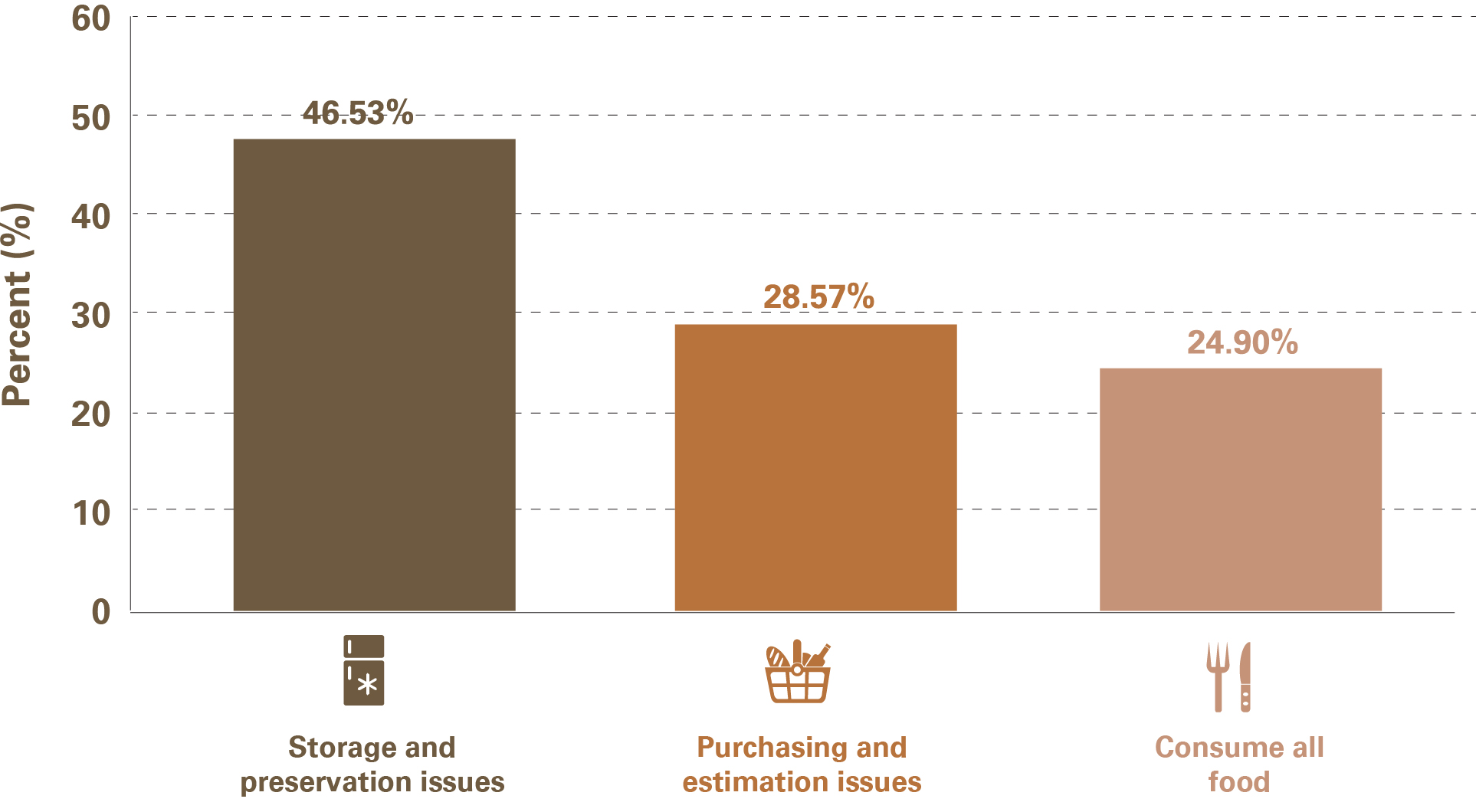
The main factors that contribute to food waste highlighted in the HSRC study include the lack of suitable storage facilities, preservation limitations and overbuying, as shown in Figure 1. Some presenters also mentioned the same issues. Consumers often purchase more food in response to promotions and bulk-buy offers and on impulse. However, food bought without a clear consumption plan frequently spoils before it can be eaten. Better shopping habits, including meal planning and purchasing according to actual household needs, could significantly reduce food waste at source. These behavioural factors are particularly important because they highlight opportunities for change that are within the reach of ordinary consumers. Small actions undertaken by millions of households can collectively have a substantial impact on reducing waste.
Figure 1. The main reasons for households not to consume all their food (number of valid observations = 2,895)
Source: HSRC 2025 Household Food Waste Study
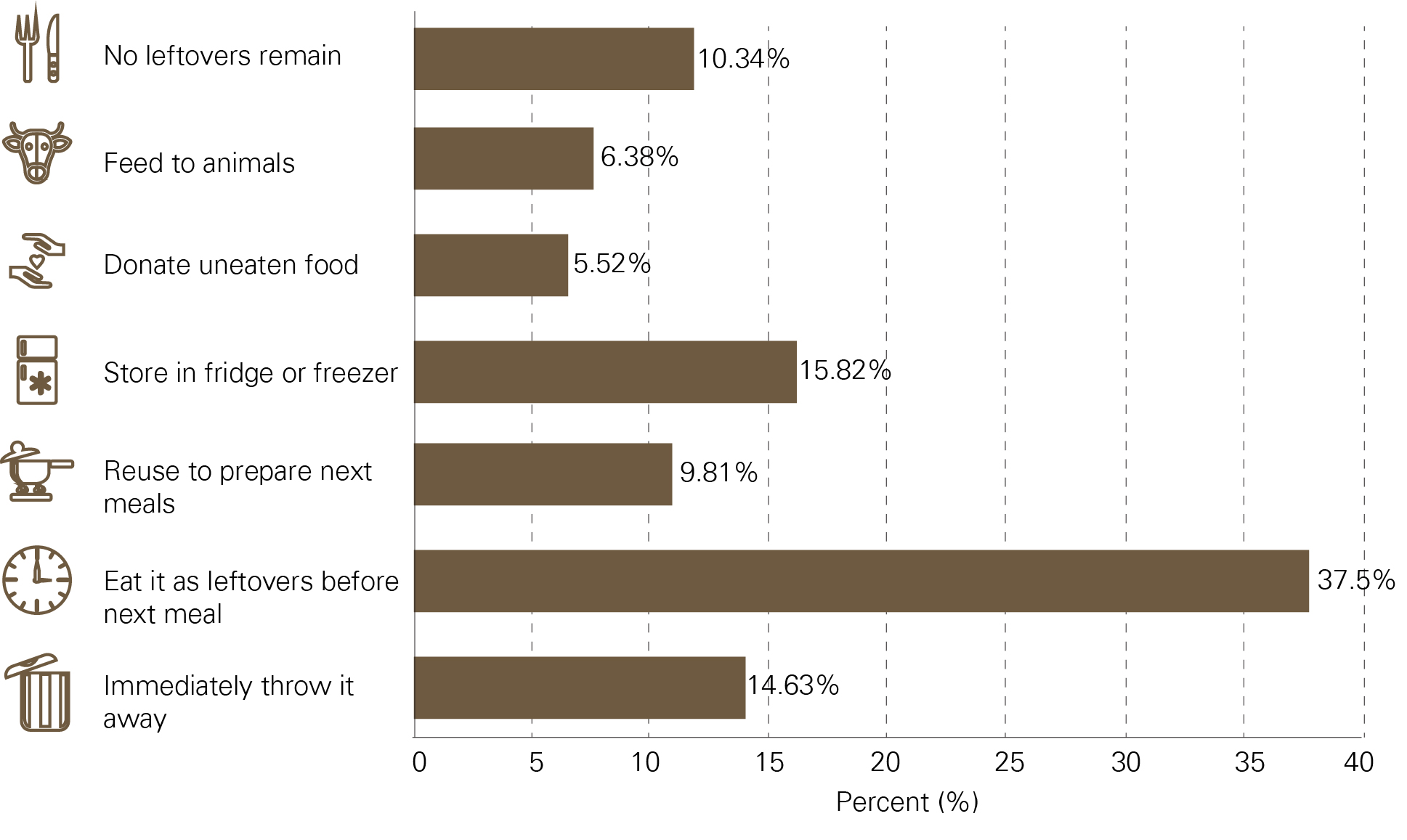
Moreover, the HSRC study found that leftovers within many households are not discarded, as shown in Figure 2. Promoting meal planning, food storage practices and creative reuse of leftovers could help households that still discard leftovers save money while reducing waste.
Figure 2. How households manage leftovers (number of valid observations = 3,027)
Source: HSRC 2025 Household Food Waste Study
A synthesis of key discussion points
The main points discussed at the two-part workshop series included the high volumes of food discarded in South Africa; the contradiction between FLW and hunger; opportunities to use surplus food to reduce hunger among vulnerable people; behavioural and structural challenges, such as the lack of electricity and refrigerators for preserving food; the buy-in of some major retailers to SA FLWI strategies; and the dangers associated with disposing food in landfills.
The workshop reinforced the strong relationship between food waste and food insecurity. In a country where many households experience hunger and struggle to access nutritious food, reducing avoidable food waste should be viewed as part of a broader food security strategy. Several speakers highlighted the growing pressure that food waste places on landfill sites. As discussed in the 2025–2030 Strategy for Reducing Food Losses and Waste and a United States Environmental Protection Agency report, when food waste is disposed of in landfills, it decomposes and releases methane. According to Jones and others (2023) and Rabbi and Kovács (2024), methane is a greenhouse gas that has a significantly higher warming potential than carbon dioxide over the short term. The environmental consequences of food waste, therefore, extend far beyond the food itself. Wasted food also represents wasted water, energy, labour and land resources used throughout production, processing and distribution.
A practical case discussed was the Western Cape Province’s efforts and commitment to diverting organic waste from landfills. It highlighted that preventing waste and finding productive uses for unavoidable organic waste must become central to South Africa’s transition towards a more sustainable, less wasteful economy.
One of the most important lessons from the workshop was that infrastructure and policy interventions alone will not solve the problem. Human behaviour remains a critical part of the food waste challenge. Encouragingly, the workshop demonstrated a growing commitment among stakeholders to address the challenge collectively. Participants from government departments, retailers, food manufacturers, research organisations and non-governmental organisations shared examples of initiatives aimed at improving management of their food stocks, redistributing surplus food, strengthening consumer education and measuring food waste more effectively. Although important actors from some parts of the value chain (primary and logistics phases) were not represented, discussions reflected a shared understanding that collaboration is essential for meaningful progress.
Conclusion
As policymakers pursue measures such as diverting organic waste from landfills and organisations continue to develop innovative waste reduction initiatives, there is growing momentum towards significant change. However, achieving lasting impact will require action from all stakeholders.
The SA FLWI workshop provided an important platform for dialogue, knowledge-sharing and collaboration. For example, one of the most valuable takeaways was the strong alignment between research evidence and the experiences of practitioners working across the food system. The CGCSA encouraged stakeholders present at the workshop to formally join the SA FLWI – joining existing members from government, academia and civil society that include the dtic, DFFE, CSIR and WRAP – to help shape debates and contribute to the national effort to reduce food loss and waste in the country.
Research contacts and acknowledgements
This Review article was written by Dr Vandudzai Mbanda (senior research specialist) and Sisonke Mtyapi (senior researcher) in the HSRC’s Equitable Education and Economies research division. For more information about this work, please contact Dr Vandudzai Mbanda at vmbanda@hsrc.ac.za.
The Food Loss and Waste study was conducted in 2025 by the Equitable and Ecological Socioeconomic Transformation team in the HSRC’s Equitable Education and Economies research division, coordinated by Dr Vandudzai Mbanda.
Special acknowledgement: We extend our sincere thanks to the CGCSA for inviting us to the SA FLWI June 2026 workshop series.