


In short
- Unemployment remains South Africa’s most pressing youth challenge, rooted in historical economic structures that continue to shape opportunities today.
- The study highlights how the apartheid-era Minerals-Energy Complex contributed to persistent spatial inequality, limited economic diversification and weak job creation.
- Post-apartheid interventions have expanded education access and created support programmes, but have had limited success in transforming employment outcomes.
- Researchers argue that youth employment strategies must be linked to broader industrial, fiscal and social policies that create jobs in more diverse sectors of the economy.
The HSRC is working on the South African component of an eight-country African study titled ‘Understanding Power, Institutions, and Policy Dynamics: A Political Economy Analysis of Youth Employment in Africa’. The team has examined how post-apartheid policies have engaged with historically rooted structures that continue to shape the most defining contemporary issue for youth in South Africa, namely unemployment. During the 1976 Soweto Uprising their frustration was about the language of instruction in schools, but now it is rooted in the absence of pathways from education into work.

Photo: Vitaly Gariev, Unsplash
The immediate trigger of the 1976 Soweto Uprising was the apartheid government’s decision to enforce Afrikaans as the medium of instruction in schools. This policy reflected a wider system of inferior, racially segregated education, which denied black learners quality education and future opportunity.
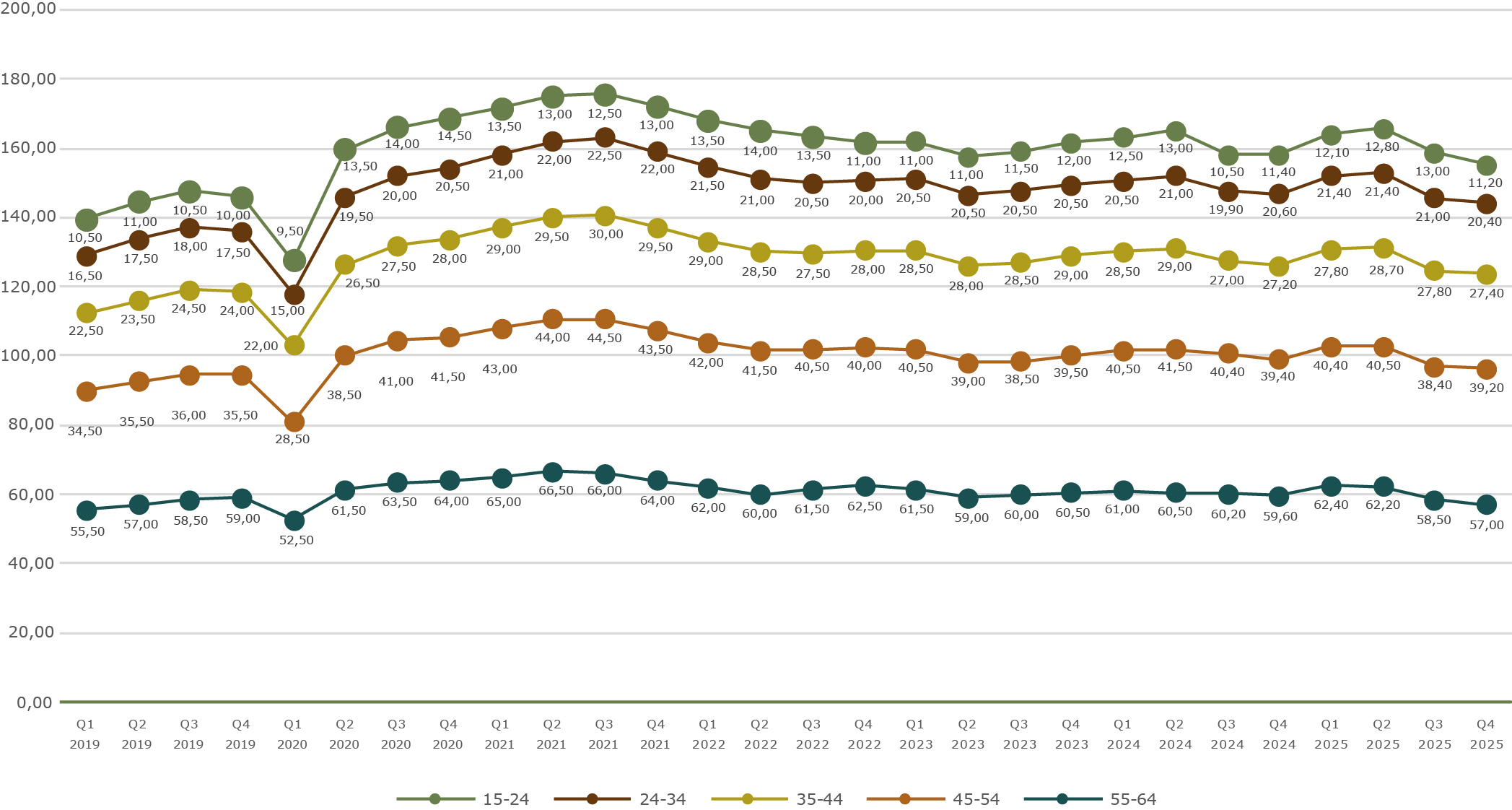
Today, youth in South Africa face a different challenge – but perhaps not entirely unrelated. With formal barriers to education abolished, they now navigate a paradox of expanded access without corresponding opportunity, where qualifications do not reliably translate into livelihoods. As a result, South Africa continues to record high rates of unemployment, with the youth most affected (Figure 1).
Figure 1. Unemployment rate in South Africa from Q1 2019 to Q4 2025, by age group
Source: Stats SA
Youth unemployment: filling the research gap
The graph above clearly shows the deepening of unemployment with each younger cohort. Post-apartheid research on youth unemployment has generally highlighted low economic growth and gaps in literacy and numeracy as key demand and supply-side constraints affecting young people’s access to work.
While this body of research has made important contributions in identifying present-day challenges and evaluating interventions, it has tended to pay less attention to how historical and structural dynamics interact with contemporary policies to shape outcomes.
To address this gap, HSRC researchers examined how historical inequalities continue to shape youth employment policies and opportunities across Africa. The work formed part of the HSRC’s contribution to the eight-country study Understanding Power, Institutions, and Policy Dynamics: A Political Economy Analysis of Youth Employment in Africa, which explored how historical structures influence current institutions, policies, and interventions.
Uneven development: the Minerals-Energy Complex
Structural factors refer to the deeply rooted political and economic arrangements that shape the distribution of resources and opportunities.
In South Africa, the structure of the economy and by extension employment trends were significantly shaped by what has been described as the Minerals-Energy Complex during apartheid. This system involved close linkages between private mining interests and state-owned enterprises in the energy sector, contributing to an economic model that relied heavily on migrant labour while restricting the permanent urbanisation of black South Africans.
Mining and energy developed strong linkages between them, such as cheap electricity from Eskom servicing mining, with weak connections between and with other sectors, producing a specific form of uneven industrial development. It was therefore not only the dominance of these sectors that is important but the way they shaped the rest of the economy through the lopsided formation that emerged.
In the post-apartheid period, this uneven structure has evolved rather than been fundamentally reconfigured. Some analysts describe a shift toward a Minerals-Energy-Finance Complex, with financialisation enabling segments of the private sector to expand globally while financial institutions have grown in prominence domestically, alongside relatively limited production of goods for trade.
This historically rooted system has contributed to uneven economic development and a lack of diversification, inhibiting job creation. It has also produced enduring spatial inequalities in both employment opportunities and living conditions. Former Bantustan areas remain among the most materially deprived, while many townships continue to be located far from centres of economic activity.
Unlike other African countries, South Africa has limited agriculture-based livelihoods because black South Africans were dispossessed of land. There are also lower rates of self-employment and a relatively small informal economy, because these were repressed in townships during apartheid.
Responses: Policies, programmes and institutions
Building on this historical overview, the study then considered how the post-apartheid youth employment ecosystem – including institutions, policies, interventions, and key stakeholders – has responded to these structural challenges. Three broad categories of interventions were identified:
a) Efforts to redress and expand access to education and skills development;
b) State-led policies and work programmes, including public employment programmes, learnerships, and tax incentives for firms to hire youth; and
c) The establishment of youth-focused policies and institutions.
Expanding access to schooling
Efforts to reform the education system have involved transforming historically segregated institutions into a formal non-racial system, with the aim of broadening access to skills and qualifications.
The South African Schools Act (1996) introduced School Governing Bodies with fee-setting powers, partly to retain middle-class participation in public schooling, while no-fee schools were established to improve access for lower-income households.
These reforms have expanded access to schooling, but have also contributed to a system in which outcomes remain uneven. Inequalities are reproduced at tertiary level. Employers are heavily influenced by the universities students attend, which becomes an indicator of their employability, with historically advantaged institutions perceived to be in a different category in terms of the calibre of student they produce.
Unifying the college system
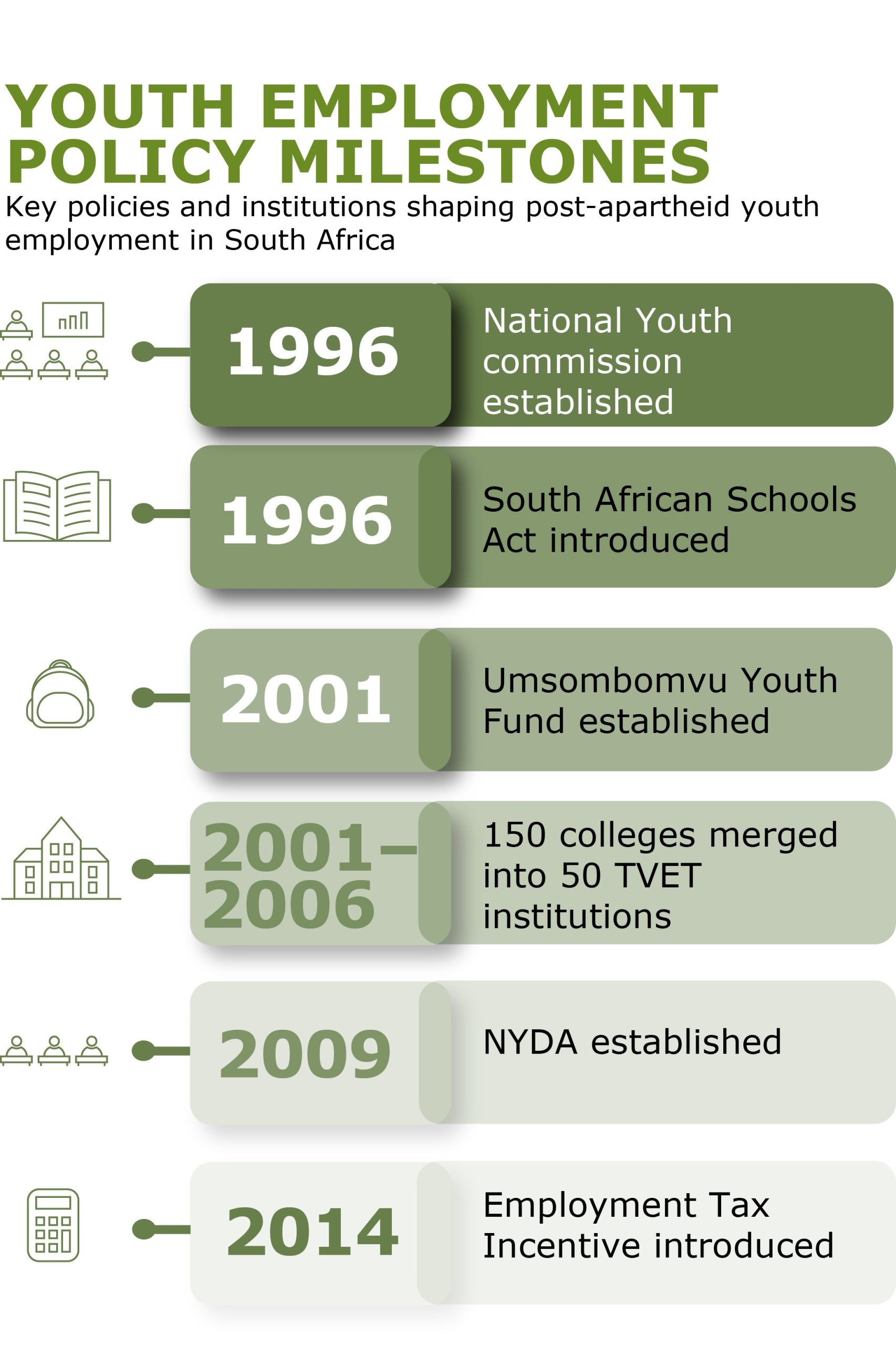
Post-apartheid, the focus of Technical Vocational Education and Training has been to unify the college system and integrate it into the vision for democratic South Africa, but limited work has been done to align industrial policy to this sector of education. More than 150 colleges were merged into 50 institutions between 2001 and 2006. A significant form of support for post-school youth has been National Student Financial Aid Scheme bursaries.
Public employment programmes
In terms of State-led policies and work programmes, public employment programmes, initially the Extended Public Works Programme and Community Works Programme, and more recently the Basic Education Employment Initiative, National Youth Service and Social Employment Fund, have provided important short-term work opportunities and income support. However, their longer-term effects on transitions into sustained employment appear to be limited.
Incentivising firms
The post-apartheid government has also offered incentives for firms to employ youth. The Employment Tax Incentive (ETI), introduced in 2014, is the most widely studied youth employment policy in South Africa. Overall, the ETI appears more effective at reducing labour costs and mitigating employment losses in specific firm contexts than at driving large-scale youth job creation. Learnerships are formal, work-based learning programmes funded through a skills levy, which firms pay to Sector Education and Training Authorities. As a low-skilled social inclusion and job creation mechanism, learnerships have produced notable results.
Youth-specific policies and institutions have expanded the visibility of youth issues within government, although challenges of coordination and integration into broader economic strategies remain. The National Youth Commission was established in 1996, followed by the Umsobomvu Youth Fund in 2001, and these amalgamated to form the National Youth Development Agency (NYDA) in 2009. The NYDA remains a statutory agency, but as of 2019, it reports to the Department of Women, Youth and Persons with Disabilities.
Three policies for youth development have been constructed post-apartheid, the first two led by the NYDA and the third by the Department of Women, Youth and Persons with Disabilities. These policies have not been accompanied by implementation plans and therefore remain somewhat toothless.
A need to coordinate youth agencies and programmes
All provincial government growth strategies include youth, as do Integrated Development Plans at municipal level, but it is unclear how these policy documents and the programmes they refer to can be linked to national structures in a more coordinated manner.
In sum, these policies, institutions, interventions and actors have enabled South African youth to gain qualifications and compete in the labour market, albeit in a way that is far from equal or fair. They have provided some economic inclusion through public employment programmes, and have incorporated youth, largely symbolically, into the architecture of government. However, they have not transformed the key tenets of the Minerals-Energy Complex that structured the South African economy during apartheid.
Public employment programmes, bursaries and the NYDA are needed and helpful, as there will never be sufficient high-quality jobs for all. However, the HSRC’s literature review for the project concluded that until industrial policy includes job creation for young people in diversified sectors, functioning to address some of the shortcomings of the lopsided Minerals-Energy Complex with its deeply entrenched spatial inequalities, attempts to deal with youth employment will be palliative rather than transformative.
Outcomes
The research was well received at a policy dialogue in Johannesburg that included representatives from government, academia, and civil society. An important comment was made by Dr Kelle Howson from the Institute for Economic Justice, who applauded the call for a focus on industrial policy but added that it needs to be integrated with fiscal and social policy.
These historical insights and policy analyses were also presented at a youth consultative dialogue held on 3 March 2026 at the Harambee offices in Braamfontein, Johannesburg, attended by 54 young people from all nine provinces. At the dialogue, participants defined meaningful and decent work as employment that offers overall job satisfaction and sufficient income to meet their needs. They identified sectors such as mining, agriculture, the blue, green, and digital economies, as well as the informal sector as holding significant potential for local opportunities. Firms were criticised by youth for neglecting corporate social responsibility, particularly in failing to invest in local skills development. Skills programmes were also seen as misaligned with local economic needs, limiting their effectiveness in facilitating youth employment.
At the dialogue, young people recognised the informal economy as a legitimate and necessary pathway to employment, rather than being a survivalist space. For many, informal work is not a temporary fallback but a primary source of livelihood, yet it remains poorly supported. Participants felt that their everyday economic realities and lived experiences were insufficiently recognised or understood. They called for research and policy to engage more effectively with their activities and provide targeted support.
The study has now moved on to the next phase, which involves interviews with 50 key informants, including academics, researchers, government officials and civil society organisations, and a quantitative analysis of youth who are not in employment, education or training.
Research contacts and acknowledgements
This Review article was written by Dr Adam Cooper (chief research specialist), Lindiwe Malumbazo (PHD research trainee) and Lesego Monyai (Department of Science, Technology and Innovation Research Intern) in the HSRC’s Equitable Education and Economies (EEE) research division, with inputs from Prof. Sharlene Swartz, EEE divisional executive. It was based on a literature review and two events. For more information about this work, please contact Dr Adam Cooper at acooper@hsrc.ac.za.
The research team also included Dr Andrea Juan and Dr Boitumelo Matlala. The HSRC hosted the events in collaboration with the African Institute for Development Policy, which also commissioned the study.