


Strengthening small-scale agri-food systems in urban, peri-urban, and rural settings in South Africa is crucial for achieving household food security and alleviating poverty. At a recent HSRC webinar, experts acknowledged the roles of small-scale actors such as street vendors, food distributors and urban farmers, and discussed ways to support and learn from them.
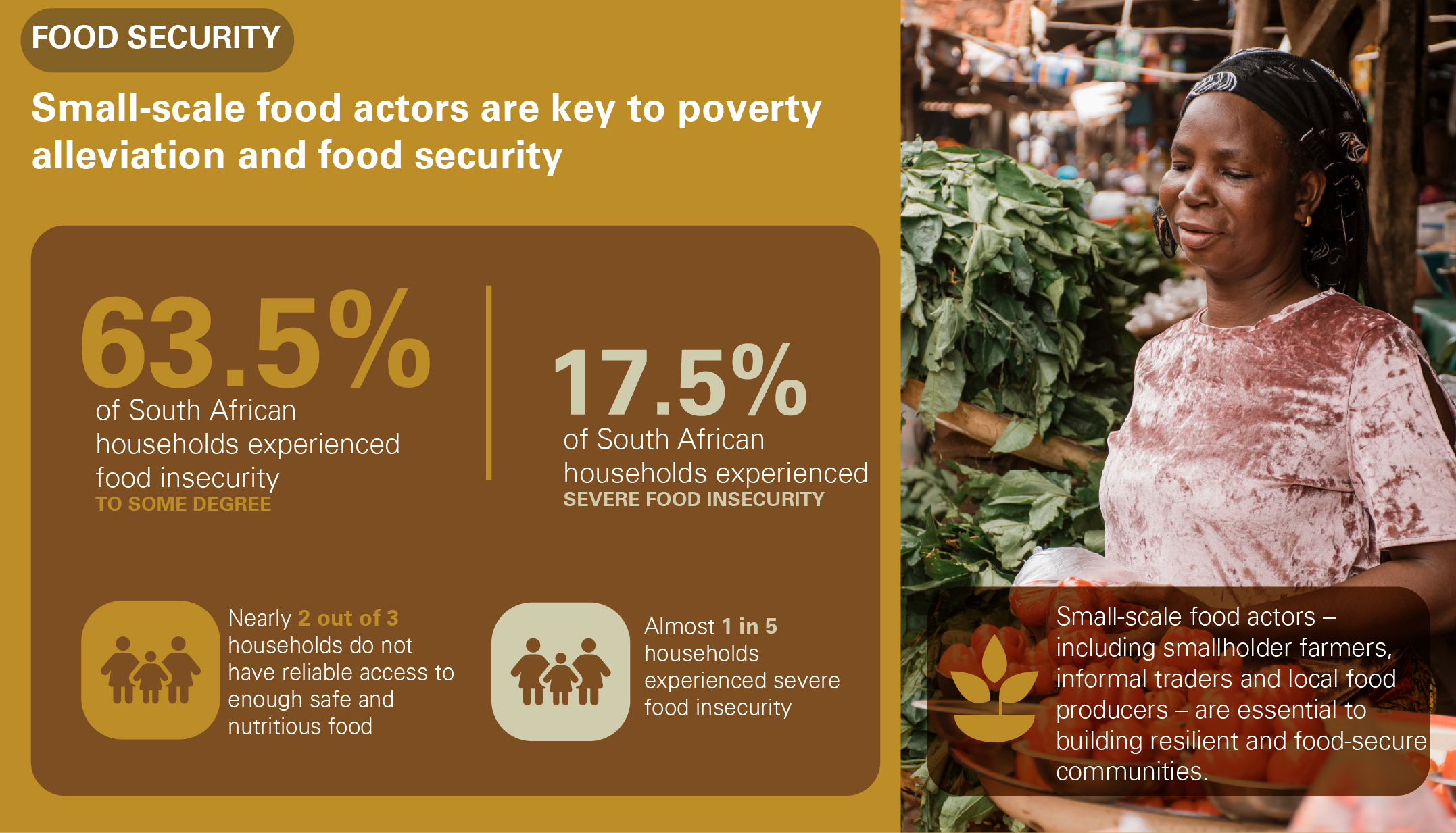
Between 2021 and 2023, the HSRC’s National Food and Nutrition Security Survey (NFNSS) gathered data from over 34 500 households across all nine provinces, providing a comprehensive picture of food access and nutrition in South Africa. Using internationally recognised indicators, the study found that 63.5% of households were food insecure to some degree. Of these households, 17.5% experienced severe food insecurity, often going without food or reducing meal sizes. Many also consumed nutritionally inadequate food, relying heavily on low-cost, nutrient-poor staples.
The findings also revealed geographic disparities, with some provinces and districts facing acute food crises. While researchers emphasised the need for clearer communication on nutrient-rich foods, dietary diversity and meal planning, the findings also pointed to structural challenges in how food is produced, accessed, distributed and consumed.
Key recommendations included investments in local food systems, including food markets and food banks located near vulnerable communities. The survey also emphasised the need to strengthen informal food economies by supporting traders and small businesses to improve food safety, quality and shelf life.
To explore these dynamics, the HSRC hosted a webinar, Strengthening Small-scale Agri-food Systems to Enhance Household Food Security & Poverty Alleviation in South Africa, in February 2026.
A food system built on dispossession
Dr Marc Wegerif, senior lecturer in development studies at the University of Pretoria and principal investigator at the DSI-NRF Centre of Excellence in Food Security, presented a diagnosis of South Africa’s food system, with half the population unable to afford a healthy diet. The NFNSS 2024 also found that 28.8% of children (1–5 years) were stunted. Nearly 68% of women were overweight or obese, which Wegerif linked to the aggressive marketing of unhealthy foods.
“We must look at the power relations across that food system, and who the winners and losers are. It’s not just a neutral system; it has power and differences and inequalities in it,” Wegerif said. The dominant food system in South Africa today grew out of a history of land dispossession, the deliberate destruction of black agriculture, and extensive state support for white-owned, large-scale commercial agriculture. “It was deliberately created,” he said.
After apartheid, ownership concentration deepened, with international investment firms and large corporates tightening their grip on the value chain from farm to shelf. The logic of that system, Wegerif argued, now fits together: vast monocrop farms feed massive distribution centres owned by a handful of supermarket groups. High levels of computerisation, mechanisation and artificial intelligence reduce the need for labour and lock out small-scale farmers who cannot meet the entry requirements of concentrated supply chains.
“The food system is not working well for a lot of people, as we see from the levels of food insecurity and unemployment,” Wegerif said.
Street traders are a system, not a gap filler
Wegerif’s research across Johannesburg, Soshanguve, Mahikeng and other sites shows that the answer is not aspirational – it is already happening on the streets. Drawing on price data collected twice monthly over two years, his team found that street traders were cheaper than supermarkets on every item measured.
He mentioned examples of street vendors undercutting a supermarket chain by 22% on onions, 60% on tomatoes, 85% on potatoes and 120% on cabbage. The formal sector’s margin on fresh produce was 179% versus 76% for street traders. Traders often absorb a portion of wholesale price increases rather than pass them on because they know their customers cannot afford it.
“The substantial savings contribute directly to people being able to access these foods, and therefore food and nutrition security,” Wegerif said.
The municipal fresh produce market system tells a similar story. The Johannesburg Market’s 2023 turnover was R23.5 billion. Between 50% and 60% of that goes to informal traders. That is more than R12 billion a year in fresh produce flowing through the hands of small-scale actors, who then typically apply a 70% markup.
“They might all look small, but collectively this is a substantive part of the food system that is making food more accessible,” Wegerif said.
Beyond price, street traders extend accessibility by selling in small, affordable units (a R5 bag of potatoes rather than a 10 kg sack), offering interest-free credit to trusted customers and bringing food directly to people’s doors via trolley delivery.
Municipal bylaws are criminalising livelihoods
Prof. Mjabuliseni Cleopas Ngidi, associate professor in food security at the University of KwaZulu-Natal (UKZN)’s Centre for Transformative Agricultural and Food Systems, examined the regulatory barriers that small-scale food actors face. He said these actors – including street traders, urban farmers, home processors, cooperatives, micro-aggregators and distributors – feed millions of urban households and sustain livelihoods, particularly for women and youth. Yet, they are systematically excluded by municipal regulations. “For me, this is a governance issue … created by how municipalities have been designing their bylaws, planning their systems and enforcing the practices,” Ngidi said.
Bylaws are designed for large, formal enterprises, not for subsistence-scale food producers. Restrictive zoning prohibits traders from operating where they and their customers live and work. Health and safety regulations impose the same compliance burden on a street vendor as on a corporate manufacturer, including costly certifications that may consume a significant share of a trader’s monthly income.
“Before you even sell one tomato, you are already illegal where you are, because the municipal zoning does not permit you to be selling where you are selling,” Ngidi said.
Small-scale food actors are rarely consulted when bylaws, integrated development plans or spatial development frameworks are drawn up – they are treated as an afterthought, or even lawbreakers. The result is a fragmented food system that misses major opportunities for employment creation and food security.
Ngidi argued that municipalities are best placed to act because they control bylaws, spatial planning, infrastructure budgets and local economic development.
Enabling steps include differentiating health compliance requirements by risk and scale; integrating food systems into development and spatial frameworks; protecting peri-urban farmland from development; and investing in infrastructure such as sheltered stalls, cold storage lockers, and access to water and sanitation.
Rethinking ‘informality’ – and the language of dignity
The webinar also raised a debate over whether ‘informality’ should be better defined, or whether it impedes good policy and research. Ngidi said inconsistent municipal definitions reinforce punitive attitudes towards so-called informality.
Wegerif challenged the framing. “I would challenge this very notion of informality. A spaza shop is very different from a street trader. Some street traders in the Joburg CBD are registered with the municipality. Why do we call them informal? The term is pejorative by its very nature. It is defining a particular group by what they’re not. That has built into it an assumption that what we need is this so-called ‘formal’ – and there’s a particular imagery about what formal is, linked to our modernisation ideas of what a modern city looks like, which come from colonial pasts.”
UKZN researcher Dr Mbalenhle Gwacela echoed the argument. “Language shapes dignity,” she said, suggesting ‘independent vendors’ as a more respectful and accurate alternative. “This is their livelihood, this is the way in which they contribute to the local economy – and to a bigger economy. There is nothing informal about that.”
HSRC researcher Kukhanyile Mali said inconsistent definitions produced fragmented government responses or even haphazard responses, further excluding actors who do not fit neatly into any category. He pointed to Gauteng during the G20 as a recent case where municipal actions against informal traders were later ruled unlawful in court.
Wegerif believes each actor in the food system should be understood for what they are and how their operation works rather than be defined by what they are not. A street food seller’s food safety logic, for example, is based on speed and personal knowledge of suppliers, not cold chains and traceability audits. “If they know the guy next door with the chickens and they slaughter the chicken in the morning, and cook it by late morning for lunch, they don’t need refrigeration. That’s a different logic of safety. If you try and apply the safety requirements designed for a Shoprite supply chain, it’s totally different, and we have to understand these actors’ way of organising and see how we work with that.”
Why this research matters
South Africa’s food insecurity crisis reflects a food system that concentrates wealth rather than nourishment. Nutrition messaging alone cannot fix a system in which half the population cannot afford a healthy diet.
This HSRC webinar showed that an alternative food system already exists in South Africa’s streets, markets and peri-urban farms. Documenting and quantifying this system through research provide the evidence needed for policy change.
The findings can help municipalities redesign bylaws that criminalise livelihoods. They can also inform spatial planning, protect peri-urban farmland, and support investment in affordable infrastructure – sheltered stalls, cold storage and water access – that would unlock greater economic participation and improve food quality. It strengthens the case for closer links between small-scale traders and farmers.
As Wegerif put it: “This is a pragmatic rather than utopian reimagining. In the streets, in imperfect situations … what we need is solutions that work in the real world.”
The researchers agreed that small-scale food actors are not a problem to be managed or a gap to be tolerated until formal systems catch up. They constitute an alternative food system that creates livelihoods, keeps prices down and feeds communities. The research and policy task is to understand how it works and learn from it.
As Ngidi concluded: “These actors are not a by-the-way kind of economic activity. They are central to the economic activities of this country.”
Authors and acknowledgements
This article by HSRC science writer Antoinette Oosthuizen is based on a webinar, Strengthening Small-scale Agri-food Systems to Enhance Household Food Security & Poverty Alleviation in South Africa, hosted in February by the HSRC’s Research Hub 4. The hub’s work on governance and stability provides context for understanding the broader conditions that enable or hinder food systems and informal economic activity in South Africa.
We thank the webinar presenters, Dr Marc Wegerif (University of Pretoria) and Prof. Mjabuliseni Cleopas Ngidi (UKZN), as well as the HSRC’s Dr Sikhulumile Sinyolo, webinar facilitator.
Please contact Dr Peter Jacobs for more information about the HSRC work in food and nutrition security:
Click here to read the HSRC’s National Food and Nutrition Security Survey (NFNSS) report.
Further reading:
Food survey shows need for area-specific interventions in SA (HSRC Review, February 2024)
Municipal support key to igniting already dynamic informal food trade system (Engineering News, February 2026)