

A new HSRC analysis reveals that while nearly three-quarters of South African scientists speak multiple languages, most still communicate science in English. Accessing this hidden national linguistic asset could transform public trust and science accessibility for many South Africans.

AI-generated image, Magnific.
Scientific information is naturally more accessible when people can engage with it in a familiar language. South Africa is highly multilingual, with 12 official languages and numerous additional indigenous, heritage and immigrant languages, yet the country’s digital news media remain predominantly English-speaking.
So, how can researchers and science communicators make science more accessible in a country shaped by deep social inequalities and uneven access to education?
A recent HSRC analysis, published in the journal article “Language, learning and engagement: Science communication skills among scientists in South Africa”, suggests that part of the answer may already exist within the science system itself. The analysis found that many of the country’s scientists are bilingual or multilingual, which broadens their potential reach as science communicators.
English dominates science communication
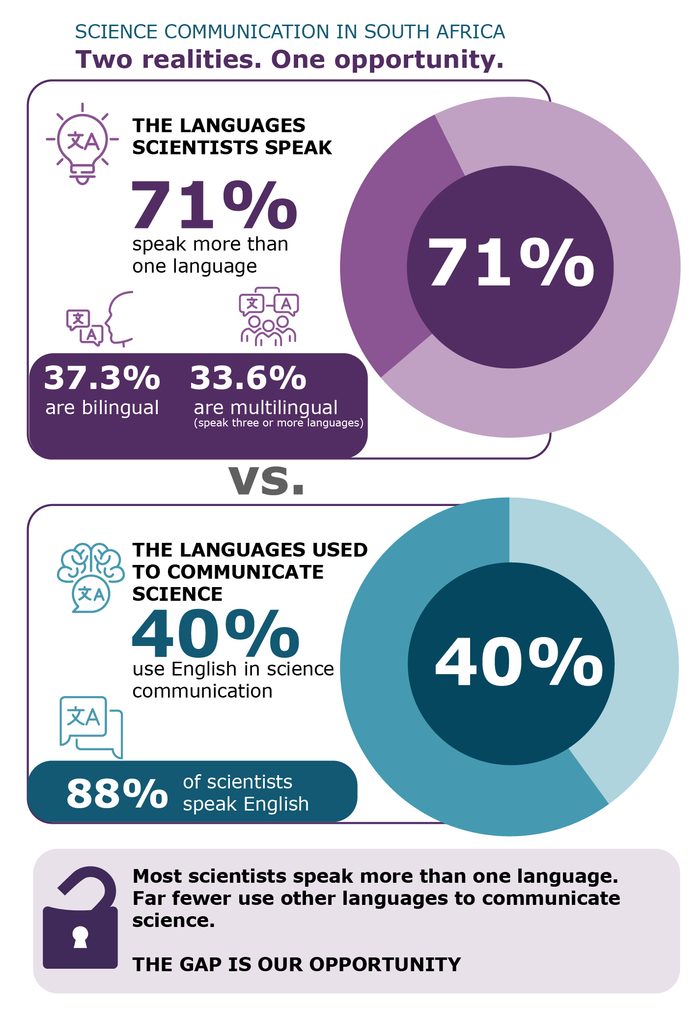
Based on a survey of 300 scientists, 71% spoke more than one language, with 37.3% being bilingual and 33.6% multilingual. However, this linguistic diversity was not being fully harnessed in science communication. English was spoken by 88% of those surveyed and remained the dominant language in science communication, used by 40% of respondents.
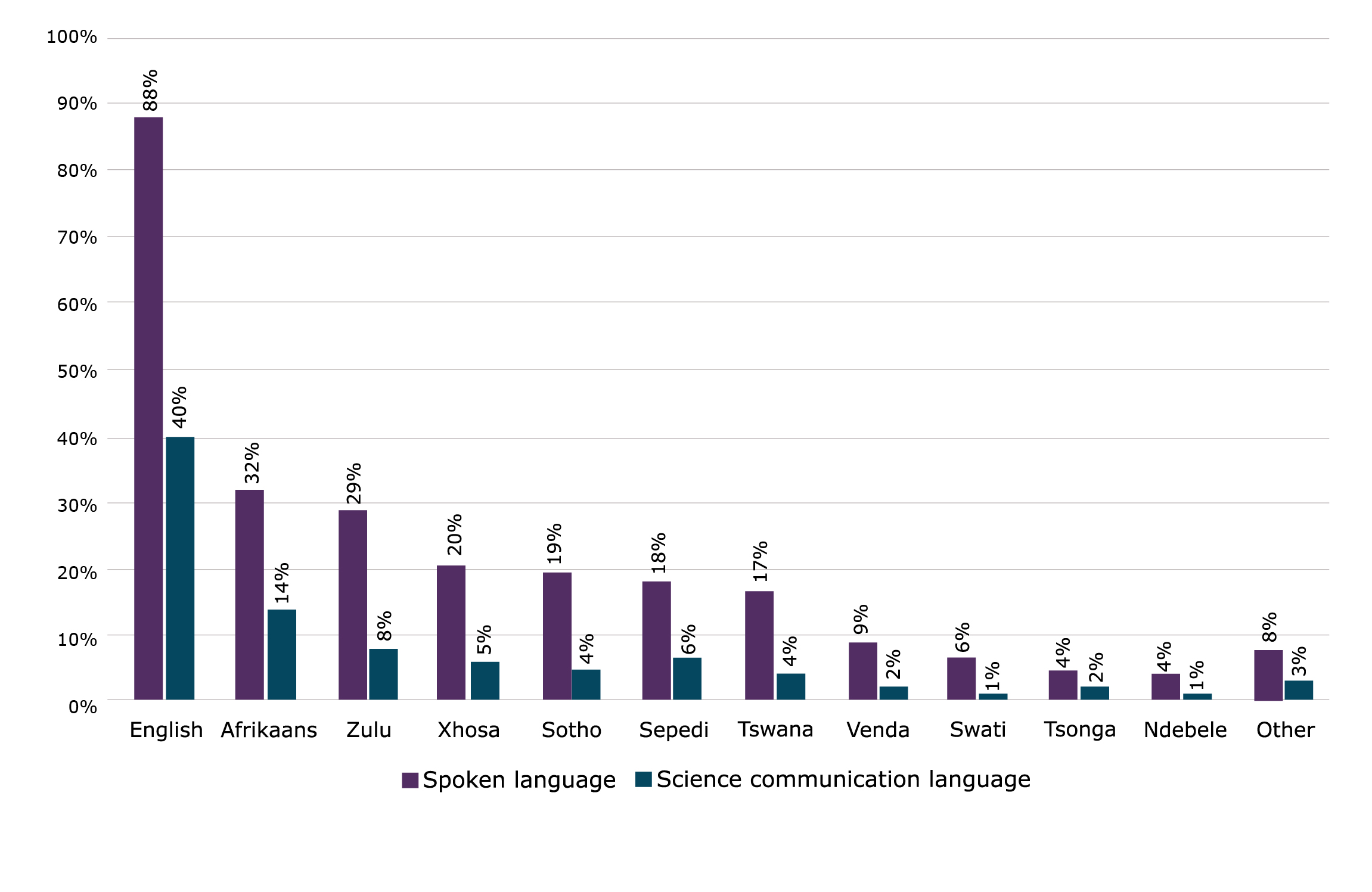
Other languages were far less frequently used, as depicted in Figure 1. Although 28.7% of respondents spoke isiZulu, only 8% used it in science communication. Similarly, isiXhosa was spoken by 20.3% but used by 5%, while Sesotho was spoken by 19% but used by just 4%.
Figure 1. Languages spoken by scientists versus languages they used in science communication, 2022
Source: Parker and Gastrow, 2026
There are several possible reasons for this disparity in language use in science communication. English is the international language of science and is often the language of higher education, publication and technical terminology. At the same time, many indigenous languages lack standardised scientific vocabulary, which makes it harder to explain specialised concepts consistently.
Building bridges between science and the public
In an era of misinformation and online confusion, clear and accessible science communication is increasingly important. Scientists play a vital social role, articulating the value of science, technology and knowledge, and the impact these have on different groups.
The 2022 South African Public Relationship with Science Survey revealed that South Africans were broadly receptive to science, although this trust was accompanied by reservations. Many respondents said there was so much science information that it was hard to know what to believe, and scientists often kept their work secret.
Who are South Africa’s science communicators?
The HSRC analysis showed that scientists involved in public science communication were more likely to be young, black, female, postgraduate-qualified, and based in Gauteng or the Western Cape. Most of the survey participants were researchers, lecturers or professionals involved in medical or engineering research. Many had already taken part in public science engagement activities: more than half had attended a science engagement event, and 40.7% had publicly presented scientific work in the previous 24 months.
There were also encouraging levels of confidence and enjoyment among scientists. About 67% said they enjoyed public communication activities, while many rated themselves highly in public speaking.
Multilingual scientists were more likely than monolingual scientists to engage a wider range of audiences. For example, 44% of multilingual scientists engaged with more than five types of audience, compared with 33% of bilingual scientists and 23% of monolingual scientists. The ability to engage with a larger number of audiences highlights the broader role of language diversity in science communication, as multilingual approaches could help bridge cultures, improve accessibility and support more inclusive participation in science. Nevertheless, factors other than language clearly influence how widely scientists engage.
A national asset waiting to be used
South Africa’s multilingual scientists are an underutilised asset. The country already has many scientists with the language skills to communicate beyond English, but to do so they need stronger institutional support. This support could include producing communication materials in different languages, offering training in cultural awareness and digital skills, and aligning these efforts with institutional language policies.
Science communication training should also be included in undergraduate curricula and a science communication competency model implemented for South Africa. The HSRC has recently overseen the development of the Science Communication Skills Development Competency Model (SCSDCM), an evaluative framework that provides clear skills development pathways for impactful, interactive public engagement.
Peer mentorship in skills development would also be useful in resource-challenged settings, which are common throughout South Africa. Rather than treating multilingual science communication as a simple matter of translation, collaboration between scientists and local communities could support the co-development of scientific terminology. This would help ensure that scientific concepts are communicated in ways that are accurate, accessible and rooted in local linguistic contexts. Such work could support science education, improve public understanding of research, and help make science feel more connected to people’s lived experiences.
Research contacts and acknowledgements
This Review article was written by Dr Saahier Parker, a senior research specialist, and Dr Michael Gastrow, a research director from the HSRC’s Equitable Education and Economies Division and HSRC science writer Jessie-Lee Smith. It is based on a journal article titled Language, learning and engagement: Science communication skills among scientists in South Africa by Parker and Gastrow. For more information, please contact Parker at sparker@hsrc.ac.za.
The research was funded by the South African Department of Science, Technology and Innovation.