


Creating jobs in rural areas has been central to South Africa’s rural development vision and policy agenda throughout the post-1994 era, with several policies calling for job generation through rural industrial development. Yet patterns of economic activity over 2010–2024 raise questions about how far jobs can be grown this way. Drawing on historical evidence, HSRC experts weigh up which economic sectors are most likely to expand the demand for workers in rural municipalities.
Photo: Noel McShane, Pexels
Since the late 1990s, South Africa’s rural development policies and strategies have been geared towards scaling up industrialisation, such as building agro-processing plants and other factories in rural areas. The National Development Plan (NDP), the Comprehensive Rural Development Programme (CRDP), the Agriculture and Agro-processing Master Plans (AAMP) and the more recent Integrated Rural Development Sector Strategy (IRDSS) see future rural spaces as localities of expanded economic opportunity, job creation and industrial enterprise (DLRRD 2025). Investing in rural industrial development and related public infrastructure, these policies promise, will be key to unlocking the prosperity and transformation of rural economies.
In 2025, the Department of Land Reform and Rural Development (DLRRD) commissioned the HSRC to generate evidence that supports the objectives of the government’s Integrated Rural Development Sector Strategy (IRDSS), a plan for rural socioeconomic change in the country that was revised in 2025. The following insights are drawn from several HSRC desktop reports submitted to the DLRRD.
Jobs from rural industries: What the ideal models promise
Promises of creating jobs by building factories near farms and mines go back centuries. The underlying premise is that siting processing and manufacturing close to the agricultural resources they depend on will stimulate local economies and, in doing so, create jobs. A sugar or flour mill sits beside the sugarcane, wheat or maize farms, for example, or a milk or cheese factory near the cattle farms it draws from.
Manufacturing plants are also expected to yield spinoffs, particularly local complementary industries such as transport, storage, packaging, and repair and maintenance. As the backward and forward linkages between farms and factories strengthen, the gains from higher productivity and added value should boost rural development. If rural industrialisation happens as envisaged, markets will expand and external investment will flow into the local economy, absorbing more of the rural workforce.
Rural manufacturing industries: quick evidence check
Whether the government’s strategy of job creation through rural industrialisation is achievable in practice depends on many factors, but economic development research across the Global South is clear: the industrial transformation of rural areas is costly and needs decades to deliver the jobs outcomes that theoretical models promise.
Historical data can reveal future industrial possibilities from past and present experience. Given the evidence, what are the prospects for manufacturing-driven jobs growth in rural areas, and what kinds of high-tech or labour-intensive factories have been built there in recent years? A rapid analysis of two basic indicators helps answer this:
1. Changing composition of economic sectors, captured as gross value added (GVA), which refers to the unique contribution of a sector to the district’s economic output
2. Share of employment per sector
On average, the employment share of a sector should be more or less the same value as the sector’s weight in gross value added. If a sector’s employment share is substantially lower than its value added to output, then this gap is likely due to the use of productivity-boosting technologies, which suggests low labour absorption in that sector.
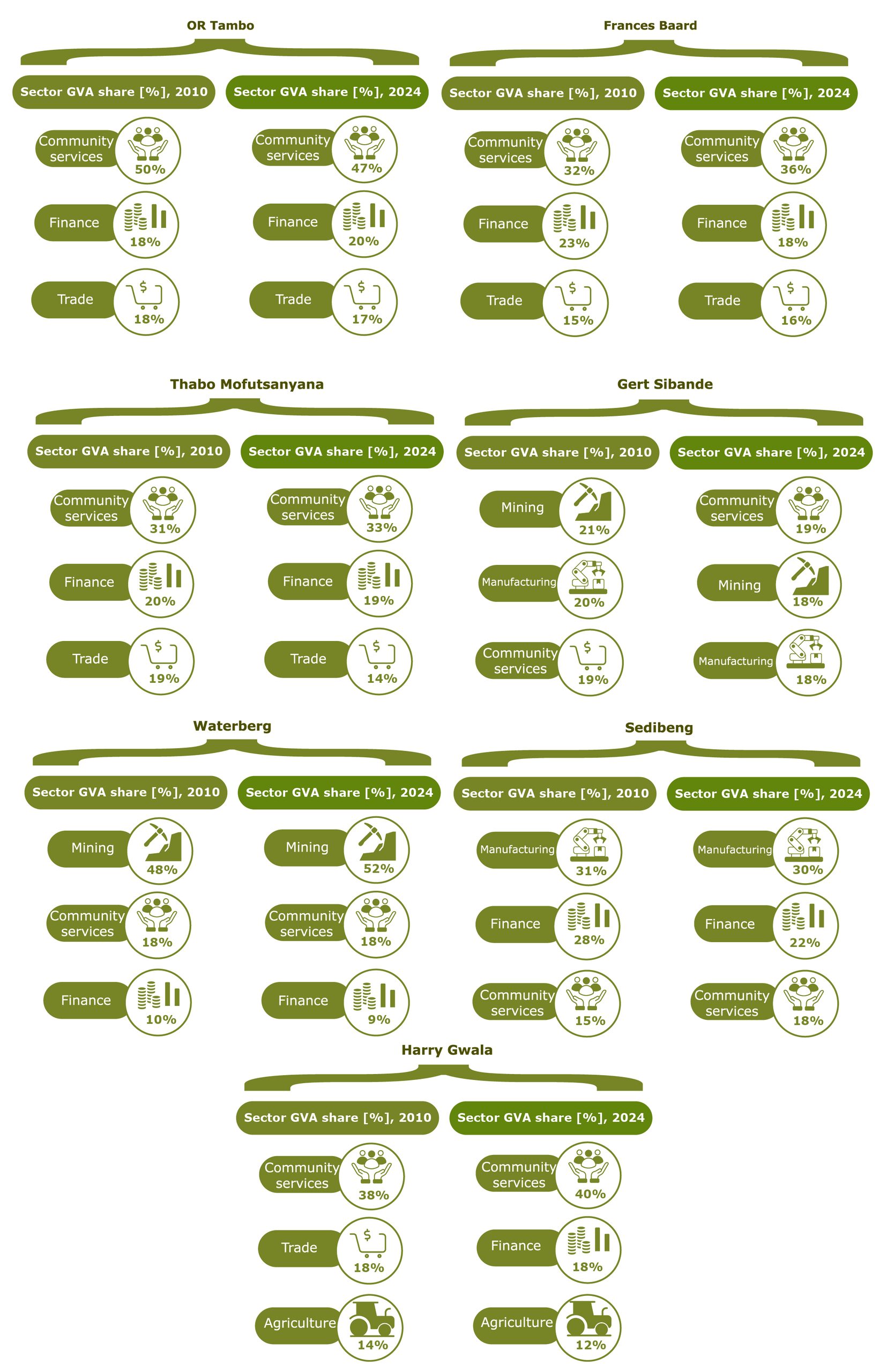
Figure 1 reports the first indicator: gross value added per sector across seven priority rural districts. It shows the value-added shares of each district’s three leading sectors in 2010–2024 – sectors that together account for 60–90% of total economic output. The question, set against the policy objectives outlined above, is whether manufacturing and agriculture feature among those driving sectors.
Figure 1. Gross value added (GVA) share [%] for top 3 economic sectors per district, 2010, 2024
Source: South Africa Regional eXplorer (ReX) 2686 (2.6y)
In Figure 1, manufacturing features in the top three of only two districts: Sedibeng (Gauteng) and Gert Sibande (Mpumalanga). Even there, the trend gives little cause for celebration. Manufacturing’s share in Sedibeng stagnated around 30%, while in Gert Sibande, it fell from 20% in 2010 to 18% in 2024.
The data reveal little about the sector itself – what the factories make (food, textiles, motor cars) or how labour intensive they are. The clearer message from Figure 1 is that services such as banking, retail trade and community services drive economic output across these districts. Only rarely do the natural resources sectors, mining and agriculture rank among the leading engines of GVA.
Rural industrial jobs patterns
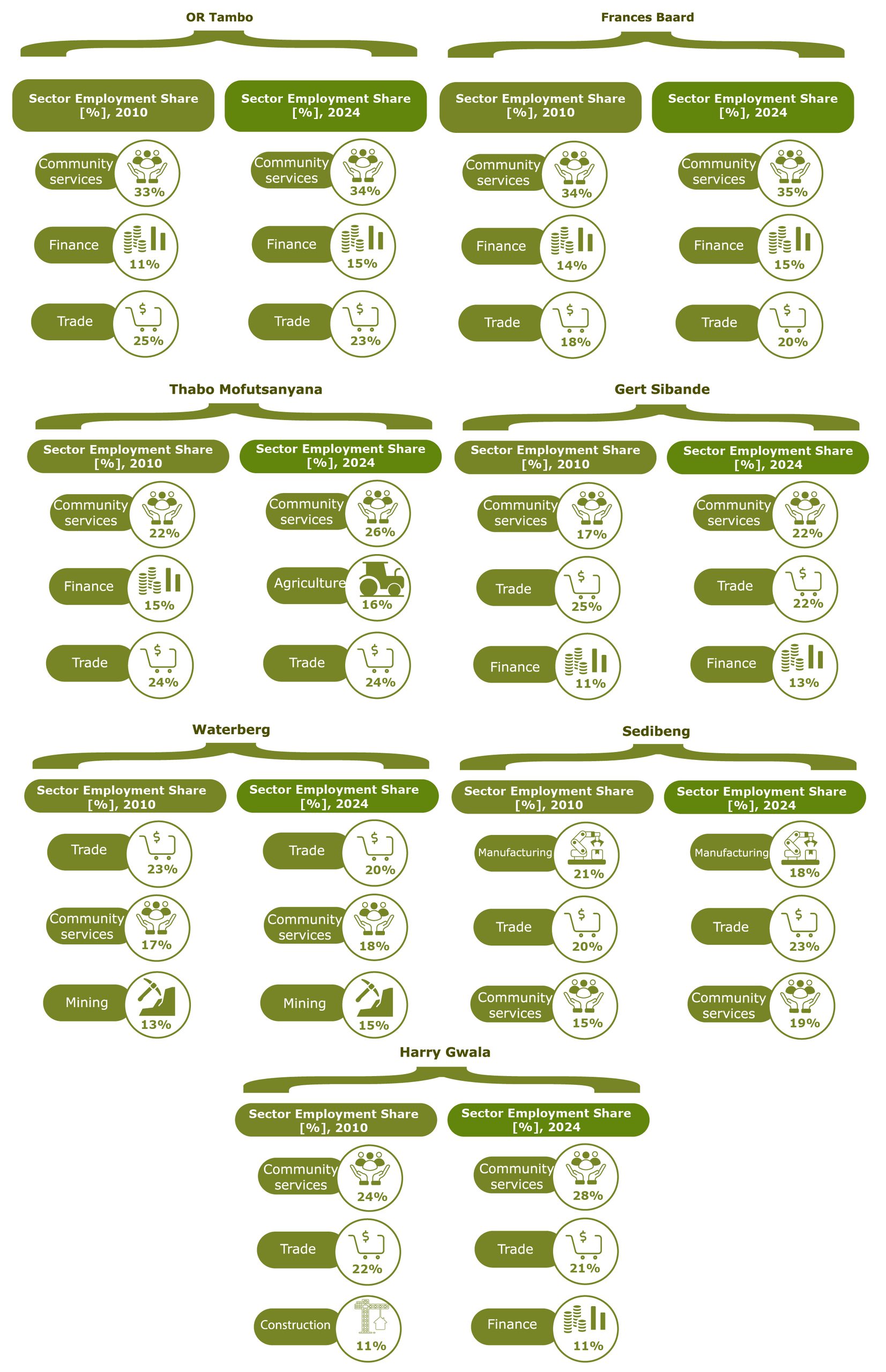
The second indicator, employment share, asks which districts have seen notable demand for factory workers, given the dismal picture of rural manufacturing. As Figure 2 shows, manufacturing jobs ranked among the top three job-generating sectors in only one district: Sedibeng.
Figure 2. Employment share (%) for top 3 economic sectors per district, 2010, 2024
Source: South Africa Regional eXplorer (ReX) 2686 (2.6y)
Sedibeng’s industrial employment may also benefit from strong linkages and spillovers from the country’s dominant manufacturing hub, Johannesburg. Yet Table 2 still clouds the outlook: Sedibeng’s manufacturing workforce share shrunk from 21% in 2010 to 18% in 2024. The likely cause is investment in labour-saving technology, which cuts demand to fewer, more highly skilled workers.
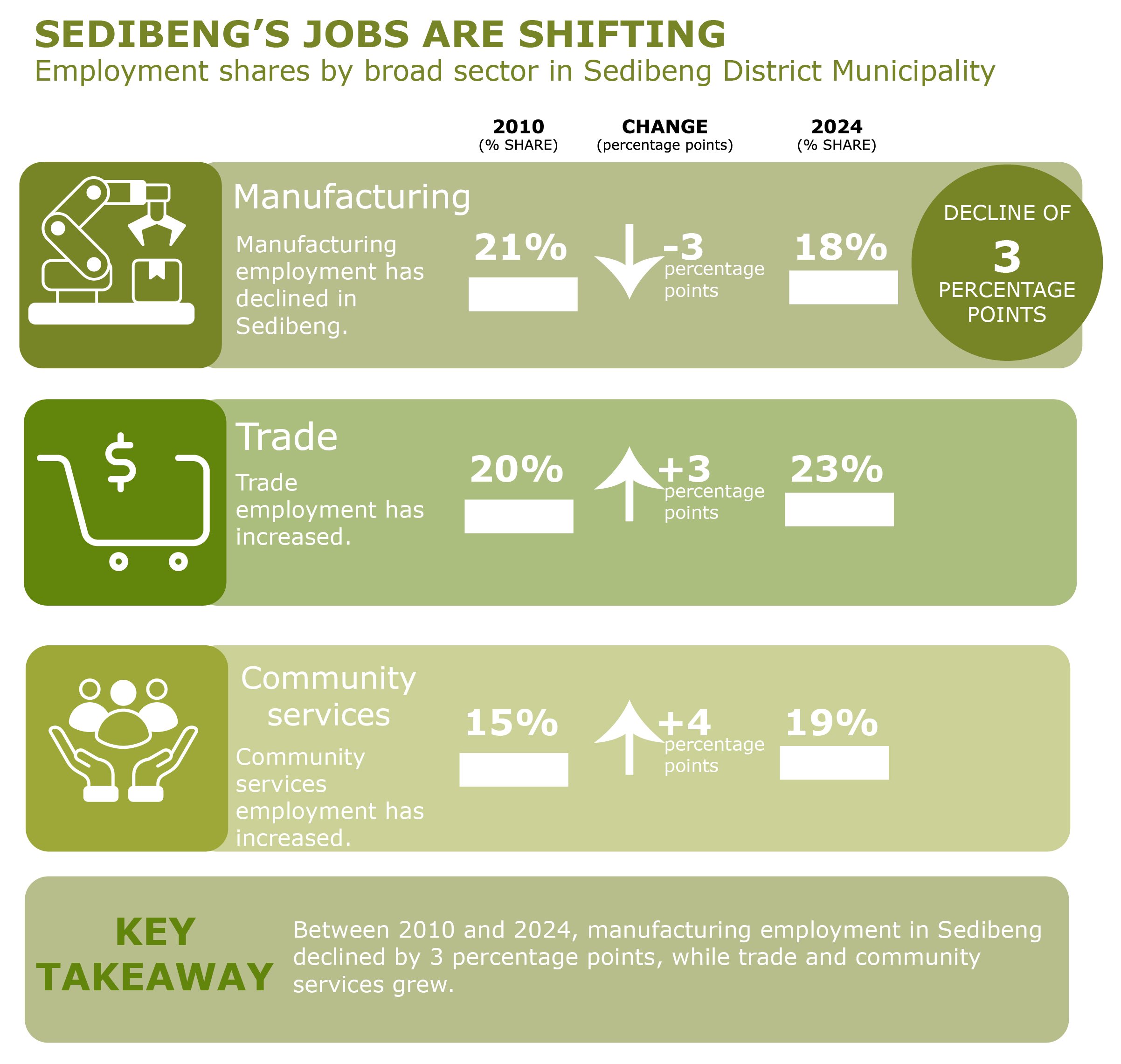
In other districts, such as Gert Sibande, factory workers make up only a small fraction of the workforce. The message from Table 2 is clear: the leading source of rural employment is the expanding services economy – retail and community services. Secure work as an agricultural or mine worker, by contrast, is increasingly unlikely. Mining and agriculture keep declining as drivers of rural jobs, and apart from modest growth in the Waterberg district (mining’s employment share rose from 13% to 15% between 2010 and 2024), there is no sign of a reversal.
Key insights
The data examined here underscore the mismatch between policy, which pins rural job creation on industrialisation, and the reality of manufacturing decline. We still know too little about the factories operating in rural areas – what they make and how many workers they employ relative to high-tech machinery. Also, service sectors rather than industry dominate rural economies and are where most new jobs are being found. Finally, the shrinking farming and mining sectors offer ever fewer prospects of secure rural work.
Authors and acknowledgements:
This HSRCReview article was written by Dr Peter Jacobs (senior research director) and Dr Kukhanyile Mali (research specialist) in the HSRC’s Equitable Education and Economies division. Jacobs is a co-PI of an HSRC team commissioned by the Department of Land Reform and Rural Development (DLRRD) to generate evidence that supports the objectives of the government’s Integrated Rural Development Sector Strategy, the government’s plan for rural socioeconomic change, which was revised in 2025. The article brings together learnings from several HSRC desktop reports submitted to DLRRD. Sisonke Mtyapi and Vandudzai Mbanda prepared the data tables discussed in this article.
For more information, please contact Jacobs at pjacobs@hsrc.ac.za.