


In short
- Digital game-based learning can improve mathematics engagement, but its success depends on more than access to technology.
- Teachers face barriers such as technophobia, limited training and concerns about classroom disruption.
- Language mismatches and weak reading skills reduce the effectiveness of digital learning tools in multilingual classrooms.
- The study argues that teacher support, multilingual design and stronger literacy foundations are essential if educational technology is to reduce rather than deepen educational inequalities.
Educational Technology (edTech) promises to transform South Africa’s mathematics learning crisis, which is characterised by low uptake and poor performance. However, in the country’s unequal and multilingual classrooms, its impact depends on more than access. edTech succeeds only when language, literacy, teacher capacity and classroom realities work together.
AI-generated image by Magnific
Mathematics plays a critical role in developing children’s reasoning, problem-solving abilities, and logical thinking, while also supporting broader economic growth and national development. Despite the importance of the subject, South Africa continues to perform below international benchmarks in mathematics education.
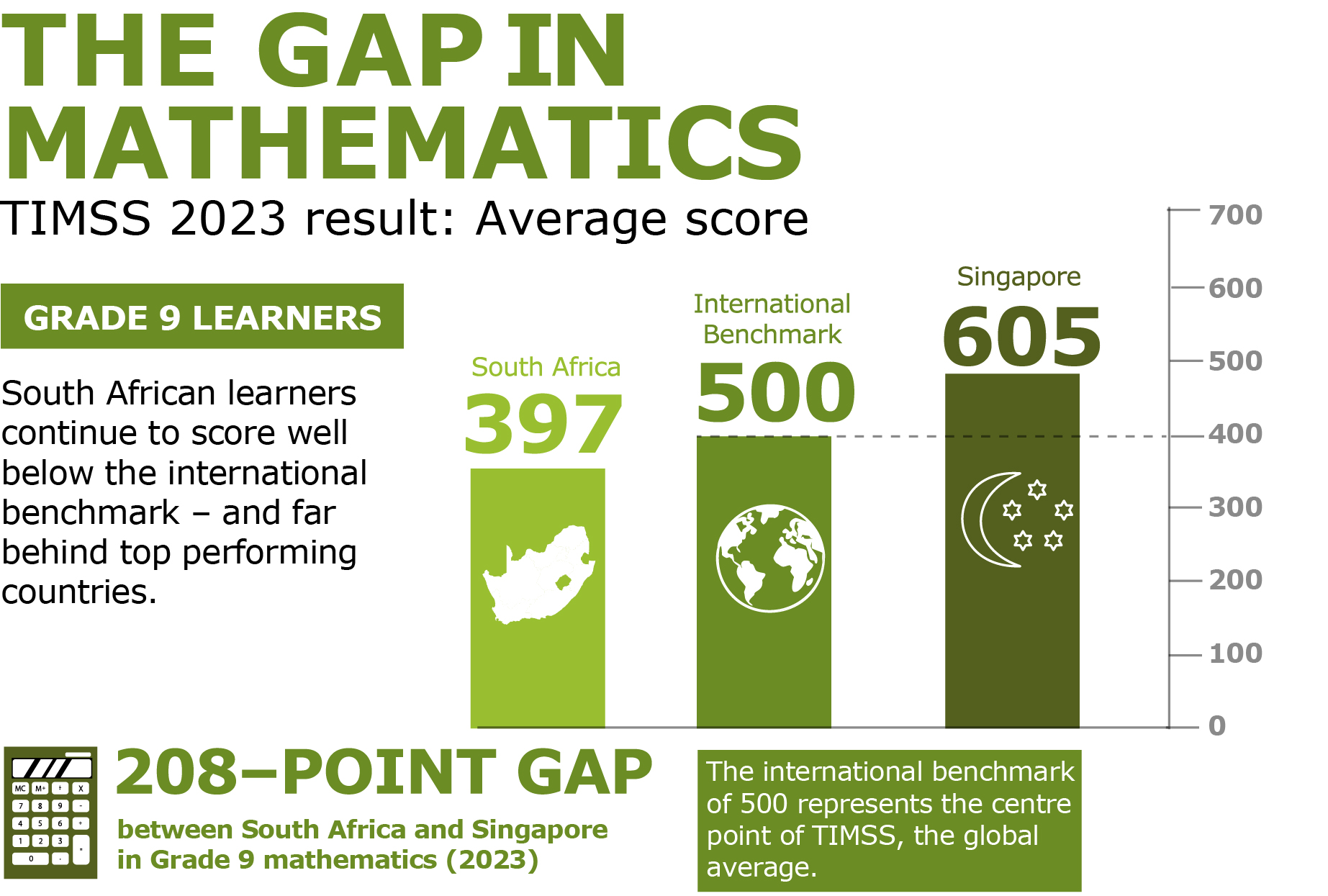
Results from the Trends in International Mathematics and Science Study (TIMSS) show that, in mathematics, South African Grade 9 learners scored 372 in 2015, 389 in 2019, and 397 in 2023, while Grade 5 learners scored 376 in 2015, 374 in 2019 and 362 in 2023. These scores all remain well below the international benchmark of 500. In contrast, high-performing Grade 9 learners in countries such as Singapore scored 621 in 2015, 616 in 2019 and 605 in 2023, consistently far above the international centre point.
In response, South African schools are increasingly exploring Digital Game-Based Learning (DGBL), which uses interactive digital games to teach curriculum content through problem-solving and immediate feedback. Research suggests that well-designed mathematics games can improve learner engagement and conceptual understanding by turning abstract concepts into interactive challenges.
However, in multilingual classrooms, language barriers and literacy gaps can limit how effectively such digital learning tools are used. This article is based on HSRC Research conducted in the Nama Khoi Municipality in South Africa, exploring the factors influencing mathematics teachers’ adoption of DGBL.
Technology Acceptance Model and the increasing use of artificial intelligence
The Technology Acceptance Model is a theory that explains how and why people reject or accept new technology. It encompasses two core ideas: perceived ease of use by the user and perceived usefulness of the technology. The study found that teachers were more likely to use digital games when they believed the tools were useful and easy to use. Language barriers, literacy gaps and technophobia strongly influenced teachers’ perceptions of the technology.
Although teachers recognised the motivational potential of digital games, the findings caution against assuming that technology alone can address systemic educational challenges. For DGBL to be effective, investment must extend beyond devices to include multilingual design, teacher training, and literacy support. As artificial intelligence (AI)-driven educational technologies expand, meaningful innovation will require alignment between technology, teacher readiness and classroom realities.
Teacher technophobia
While teachers generally recognised the potential of DGBL to improve learner engagement in mathematics, several contextual challenges limited effective adoption. One of the most significant barriers was teacher technophobia.
Some teachers expressed anxiety about using digital tools, particularly when they were unfamiliar with the platforms or feared technical failure during lessons. This hesitation does not reflect resistance to change, but limited exposure, inadequate training, and a lack of sustained institutional support.
Teachers reported that setting up digital games was time-consuming and sometimes disruptive to lesson flow. As a result, even when they believed DGBL could enhance learning they were cautious about regularly integrating it into their teaching practices.
Learners’ limited reading skills
Learners’ limited reading skills emerged as another important barrier to the effective use of digital games in mathematics classrooms. This challenge was particularly evident in multilingual settings, where the language used in digital games (English) did not correspond with learners’ home languages (in this case, Afrikaans). As a result, learners often first had to translate or decode the English instructions before engaging with the mathematical task.
Many digital games require learners to read instructions, interpret word problems, and respond to written feedback. Teachers observed that learners who struggled with reading comprehension found it difficult to engage with the games fully.
From a cognitive perspective, this reflects an issue of cognitive load: learners’ working memory becomes overburdened when they must process a second language while simultaneously attempting to solve a mathematical problem. Instead of focusing on mathematical reasoning, a substantial portion of their cognitive capacity is diverted to language decoding.
Consequently, learners often needed additional support to understand tasks before attempting the mathematics problem, slowing the lesson pace and reducing the effectiveness of DGBL. This highlights how language mismatches and literacy constraints can undermine the potential benefits of digital learning tools in multilingual classrooms.
Parental perceptions of digital games in classrooms
Parental attitudes also influenced the uptake of DGBL. While many teachers viewed digital games as an innovative way to enhance engagement in mathematics, some parents were sceptical about the use of games in formal learning. For many families, games are associated primarily with entertainment rather than academic work. As a result, teachers sometimes felt compelled to justify or limit the use of digital games in the classroom, even when they believed the approach could support learning.
Impact: Supporting effective use of DGBL
This research study contributes evidence to ongoing debates about educational technology, AI in classrooms and digital inequality. It highlights the promise and the limitations of DGBL in addressing South Africa’s mathematics learning crisis.
While DGBL can increase engagement and support conceptual understanding, its effectiveness is constrained by the dual challenge of weak numeracy and foundational literacy skills within a multilingual and unequal schooling system. The study shows that successful implementation depends not only on teachers’ recognition of the potential of digital games to improve engagement and problem-solving, but also on addressing South Africa’s structural constraints, such as technophobia, limited teacher training, low parental buy-in, language barriers, and learners’ reading difficulties.
Technology alone will not resolve underperformance in mathematics. For digital innovation to improve learning outcomes, investments must also strengthen teacher training, multilingual accessibility, and foundational literacy. The insights from the study can inform policy design, teacher development programmes, and edTech innovation. Education departments can use the findings to strengthen information and communication technology integration strategies by aligning them with literacy development and language diversity. Teacher training institutions can incorporate digital pedagogy and confidence building into their programmes. At the same time, developers of digital learning tools, including AI-supported platforms, can design more accessible, user-friendly and language-inclusive games.
The findings have been discussed at several conferences and meetings attended by different stakeholders: civil society, government officials, and researchers. By informing policymakers, curriculum planners, and edTech developers, this work offers a pathway toward a more inclusive and effective digital learning strategy in South Africa’s mathematics classrooms. Without such alignment, digital innovation risks reproducing or even deepening existing inequalities.
Research contacts and acknowledgements
This Review article was written by Lindiwe Malumbazo, a PhD research trainee in the HSRC, Equitable Education and Economies (EEE) division, Lesego Monyai (DSTI intern, EEE) and Dr Petronella Saal (research specialist, EEE). This article is based on the paper Unlocking the Power of Play: Exploring Key Influences of Digital Game-Based Learning Adoption Among South African Mathematics Teachers by Dr Petronella Saal, Dr Ncediwe Mdlulwa and Sylvia Hannan.
For more information about this work, please contact Dr Petronella Saal at psaal@hsrc.ac.za.