


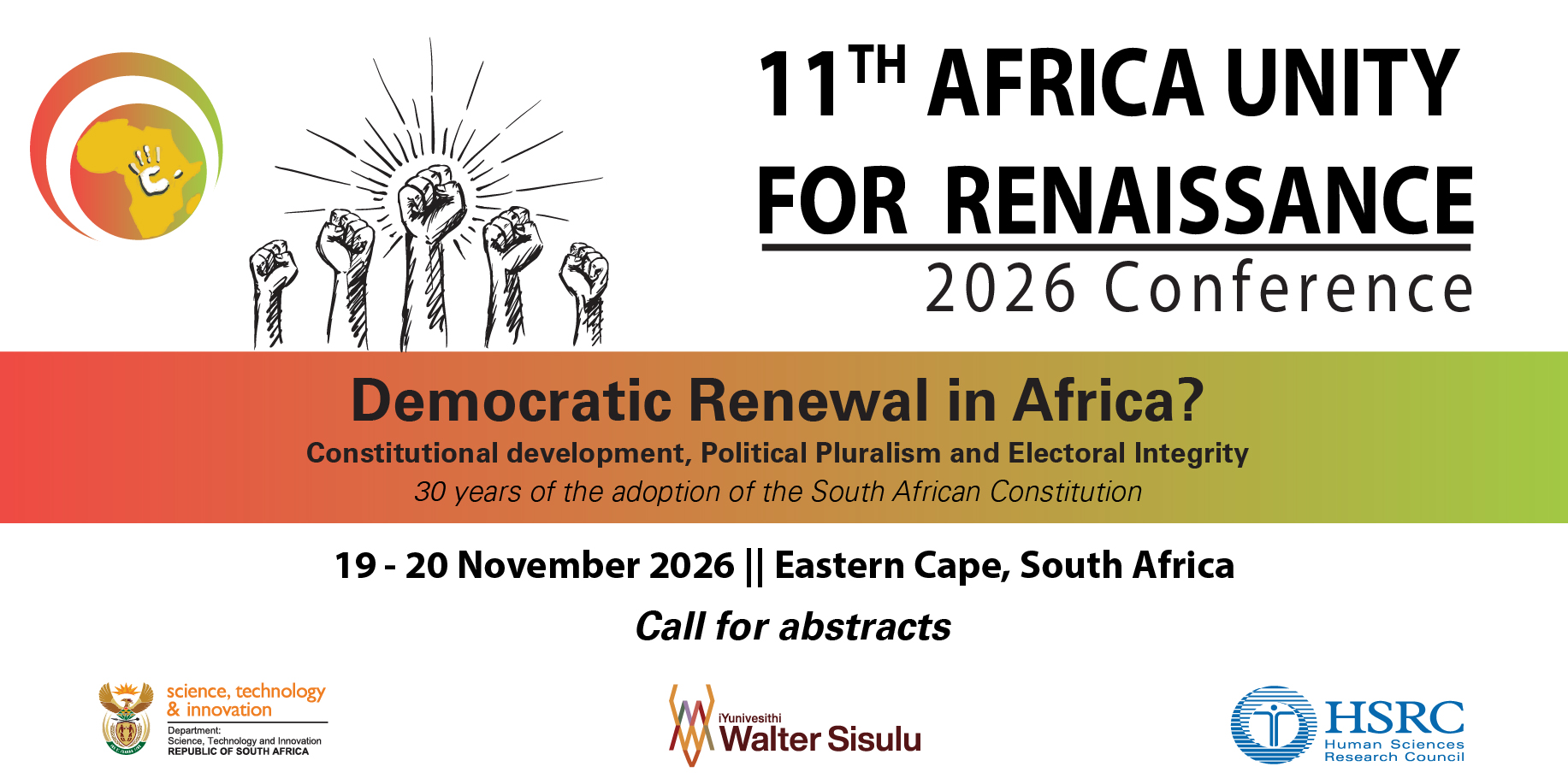
The Human Sciences Research Council (HSRC), with its partner, iYunivesithi Walter Sisulu, will hold its 11th Africa Unity for Renaissance Conference (AURC) on 19-20 November 2026 in the Eastern Cape, South Africa. The 2026 conference coincides with the 30th anniversary of the adoption of the Constitution of the Republic of South Africa (1996), a landmark in Africa’s democratic history and one of the world’s most progressive constitutional frameworks. Over the past three decades, the Constitution has provided the foundation for democratic Governance, the protection of human rights, the rule of law, accountable government, and regular, free, and fair elections. This anniversary presents an important opportunity not only to reflect on South Africa’s constitutional journey, but also to examine the broader trajectory of constitutional Democracy and electoral Governance across Africa.
Primarily, a country’s Constitution legally regulates how power is divided between the central administration and regional governments and determines how the government exercises power in a rational, responsible manner that considers the needs and wants of the population. Importantly, constitutionalism combines the idea of a government limited in its actions with the idea of a government accountable to its citizens for its actions. Post-1990 constitutional development in Africa reveals that most of them contain six core elements of modern constitutional-making processes. These include (1) provisions that recognise and protect fundamental rights and freedoms, (2) provisions on the separation of powers, (3) provisions for an independent judiciary, (4) provisions for controlling the constitutionality of laws, (5) provisions that control the way the Constitution is amended, and (6) provisions for institutions designed to support and sustain Democracy.
The constitutional development process in Africa is arguably the central pillar that has enabled the proper functioning of the state and in addressing major problems facing Africa, such as internal conflict, inequality, underdevelopment, and pervasive poverty. The constitution-making process on the continent has also ensured that political rights are upheld, that political pluralism is maintained, and, more importantly, that regular elections are held. Presidential terms are limited to facilitate the alternation of power.
AURC 2026 themes
The theme of this year’s conference is ‘Democratic Renewal in Africa? Constitutional Development, Political Pluralism and Electoral Integrity. Fundamentally, constitutionalism, political pluralism, and the integrity of election management bodies form a triad that underpins democratic stability in Africa. While many African states have adopted the formal architecture of democracy, in practice, their democratic trajectories often shift between consolidation and backsliding. Across the continent, constitutionalism is frequently shaped by the tension between formal constitutional provisions and their substantive implementation. A constitution limits executive power and requires that it be exercised rationally, responsibly, and within defined constraints.
The conference will examine the dynamics of political pluralism across Africa, with particular attention to political competition as a foundation of democratic processes. Additionally, the theoretical conceptualization of governance, leadership and institutional integrity in Africa’s democratic renewal will form a central knot of the conversation. In this context, the integrity of election management bodies (EMBs) is critical. Their credibility largely determines whether elections are viewed as genuine expressions of the will of the people or as processes shaped to preserve incumbency.
Abstracts are invited on pertinent aspects of constitutional development in Africa, pluralism in Africa’s political space, and the integrity of EMBs in Africa. The conference is structured to cover the following sub-themes:
1. Thirty years of South Africa’s Constitution: lessons for Constitutional Democracy
2. Constitutional development and the consolidation of democratic traditions in Africa;
3. Unconstitutional and constitutional amendments: implications for institutions supporting Democracy and good Governance in Africa;
4. Democratic Regression, Political Opportunism and Popular nationalism in Africa.
5. Governance, leadership, and institutional integrity in Africa’s democratic renewal
6. Civil society organizations and the challenges of monitoring elections in Africa;
7. One-party state and political pluralism in Africa: The paradox of Africa’s governance processes;
8. Institutions, Governance, and policy landscape of managing elections in Africa
Please specify for which sub-theme you would like your abstract to be considered. Abstracts or panel proposals should not be longer than 300 words and include full details (name/s, title, institutional affiliation, position, e-mail, and telephone number) of the authors.
Abstracts will be assessed against the criteria of originality, quality, relevance, and potential impact. To allow adequate time for discussion, engagement, and networking, only a limited number of abstracts will be selected for oral presentation.
Key dates
Abstract submission deadline: 14 September 2026
Notification to authors of selected abstracts: 22 September 2026
Final paper submission deadline: 19 October 2026
Conference dates: 19 – 20 November 2026
Abstracts should be submitted via e-mail in Microsoft Word format to: aurc2026@hsrc.ac.za

